Infectious disease
Getting started guides
:quality(80))
A guide to microbial sequencing with Oxford Nanopore
A guide to get started with sequencing microbial samples with Oxford Nanopore.
Most viewed
:quality(80))
Oxford Nanopore sequencing solutions for microbiology and infectious disease research
In this brochure, discover Oxford Nanopore sequencing techniques that can reveal multidimensional insights for your microbial research applications.
:quality(80))
A successor to Sanger: accurate, full-length, and haplotype-resolved amplicon sequencing with Oxford Nanopore
In this application note, we evaluate Oxford Nanopore sequencing for amplicon analysis using matched datasets generated with both Oxford Nanopore and Sanger sequencing.
:quality(80))
Oxford Nanopore sequencing provides superior metagenome-assembled genome recovery and strain-level resolution from a complex microbiome
In this application note, we demonstrate the
capabilities of Oxford Nanopore metagenomics by
sequencing and analysing the well-characterised
ZymoBIOMICS Fecal Reference.
:quality(80))
Oxford Nanopore whole-genome sequencing of foodborne pathogens
In this application note, we demonstrate the suitability of Oxford Nanopore sequencing as a standalone platform for foodborne pathogen whole-genome sequencing.
:quality(80))
GridION: one sequencer for many
Made with multiple projects and teams in mind, GridION gives you the freedom to start, stop, and scale your sequencing experiments without impacting others. Meanwhile, onboard compute keeps your real-time data optimised. Discover more.
Workflow overviews
:quality(80))
Nanopore-only microbial isolate sequencing solution (NO-MISS): flexible, rapid bacterial and fungal isolate whole-genome sequencing
This end-to-end workflow provides a rapid solution for whole-genome Oxford Nanopore sequencing of bacterial and fungal isolates.
:quality(80))
Streamlined identification of bacteria, archaea, and fungi with Oxford Nanopore microbial amplicon barcoding
This end-to-end workflow introduces how to sequence the full length 16S gene and ITS region with Oxford Nanopore technology.
:quality(80))
Rapid and complete plasmid characterisation with Oxford Nanopore sequencing
This end-to-end workflow is a rapid method for complete, high-quality whole-plasmid characterisation.
:quality(80))
Rapid viral sequencing for genomic surveillance of mpox using metagenomic or targeted approaches
This end-to-end workflow provides guidance for both metagenomic and targeted viral genome sequencing to deliver rapid and actionable results.
:quality(80))
Rapid identification of respiratory pathogens with Oxford Nanopore metagenomics
This end-to-end workflow introduces how to rapidly identify bacterial, fungal, and viral pathogens from respiratory research samples using metagenomic Oxford Nanopore sequencing on a MinION or GridION.
Featured resources
:quality(80))
Embedding clinical metagenomics into NHS diagnostic pathways | LC26
Clinical metagenomics is a rapidly advancing field in infectious disease diagnostics, using next-generation sequencing to identify pathogens directly from clinical samples without prior assumptions. In this presentation, Dr Adela Alcolea-Medina will describe the development, validation, and national
:quality(80))
How do I perform real-time targeted Oxford Nanopore sequencing?
What if targeted sequencing took place during sequencing itself, without the need for special library prep, PCR, or probes? In this demo, discover Adaptive Sampling: a unique, real-time targeted enrichment/depletion method that achieves just that.
:quality(80))
Pan-microbial pathogen detection in hours using metagenomic sequencing
In this case study, discover how the UK NHS Respiratory Metagenomics Network have developed a rapid Oxford Nanopore sequencing workflow that can detect the bacteria, viruses, fungi, and parasitic pathogens underlying respiratory infections in a matter of hours.
:quality(80))
Which library prep workflow is right for my experiment?
Whether you’re sequencing DNA, RNA, or cDNA, a single sample or many in multiplex, there’s an Oxford Nanopore library prep kit for you. In this masterclass, discover how to choose the right one for your workflow.
:quality(80))
Delivering the future of genomic pathogen surveillance with Oxford Nanopore sequencing
Achieve comprehensive, affordable, and real-time analysis of human and animal pathogens with nanopore sequencing.
Protocols
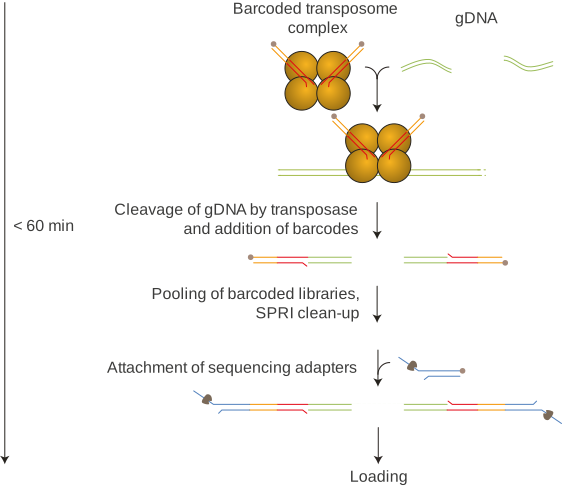
Rapid sequencing DNA V14 - barcoding (SQK-RBK114.24 or SQK-RBK114.96)
Learn how to perform rapid genomic DNA barcoding using the Rapid Barcoding Kit V14 (SQK‑RBK114.24 / SQK‑RBK114.96). This fast, high‑yield library preparation workflow enables multiplexing of up to 96 gDNA samples with ~60‑minute prep time and compatibility with R10.4.1 flow cells.
Ligation sequencing gDNA - Native Barcoding Kit 24 V14 (SQK-NBD114.24)
This protocol describes how to carry out native barcoding of genomic DNA (gDNA) using the Native Barcoding Kit 24 V14 (SQK-NBD114.24).
Ligation sequencing gDNA - Native Barcoding Kit 96 V14 (SQK-NBD114.96)
This document describes the barcoding of native genomic DNA libraries.
For Research Use Only
:quality(80))
SARS-CoV-2 virus PCR tiling and sequencing from RNA using SQK-RBK114.96
This protocol is for the extraction and sequencing of ultra-high molecular weight (uHMW) genomic DNA.
Influenza virus sequencing from RNA using SQK-NBD114 (.24 or .96)
This document describes the sequencing of the influenza virus.
For Research Use Only
Analysis workflows
Latest research
:quality(80))
Strengthening MRSA genomic surveillance in the Pacific
Discover how strengthening local sequencing and bioinformatics capacity can support sustainable pathogen surveillance and informed public health responses across the Pacific.
:quality(80))
Linkage blocks involving multiple replicons organize Borrelia burgdorferi strain variation and influence virulence in Lyme disease
Authors: Rachel A. Laing, Michael J. Foster, M. Amine Hassani, Benjamin Kotzen et al.
:quality(80))
Exploring the methylation dimension
Watch this webinar to learn more about leveraging Oxford Nanopore gold standard methylation sequencing in your research.
:quality(80))
Nanopore metagenomic sequencing links clinically relevant resistance determinants to pathogens
Authors: Harika Ürel, Ela Sauerborn, Michael Biggel, Friedemann Gebhardt, Ebenezer Foster-Nyarko, Silvio D Brugger, Rhys T White, Søren Heidelbach, Mads Albertsen, Francis Muchaamba, Tim Reska, Marc J A Stevens, Roger Stephan, Richard Fetherston, Lara Urban
:quality(80))
Metagenomics and microbial bioinformatics: latest tools and workflows
In this video, researchers discuss practical research applications, current challenges, and future directions in microbial bioinformatics. We explore how Oxford Nanopore sequencing can characterise complex microbial communities at greater resolution than legacy methods.