Environmental research and conservation
Getting started guides
:quality(80))
A guide to microbial sequencing with Oxford Nanopore
A guide to get started with sequencing microbial samples with Oxford Nanopore.
Most viewed
:quality(80))
Oxford Nanopore sequencing solutions for microbiology and infectious disease research
In this brochure, discover Oxford Nanopore sequencing techniques that can reveal multidimensional insights for your microbial research applications.
:quality(80))
GridION: one sequencer for many
Made with multiple projects and teams in mind, GridION gives you the freedom to start, stop, and scale your sequencing experiments without impacting others. Meanwhile, onboard compute keeps your real-time data optimised. Discover more.
:quality(80))
MinION: palm sized, world ready
Discover how the portable yet powerful MinION Mk1D sequencing device can take your insights further afield. Start generating rapid, real-time results without compromise.
Workflow overviews
:quality(80))
Nanopore-only microbial isolate sequencing solution (NO-MISS): flexible, rapid bacterial and fungal isolate whole-genome sequencing
This end-to-end workflow provides a rapid solution for whole-genome Oxford Nanopore sequencing of bacterial and fungal isolates.
Featured resources
:quality(80))
Genomics for a changing planet: sequencing the living world
Discover how a global community of researchers are harnessing Oxford Nanopore sequencing to study the far-reaching impacts of climate change, revealing deep insights across environmental research, agriculture, and pathogen surveillance.
:quality(80))
How do I perform real-time targeted Oxford Nanopore sequencing?
What if targeted sequencing took place during sequencing itself, without the need for special library prep, PCR, or probes? In this demo, discover Adaptive Sampling: a unique, real-time targeted enrichment/depletion method that achieves just that.
:quality(80))
Which library prep workflow is right for my experiment?
Whether you’re sequencing DNA, RNA, or cDNA, a single sample or many in multiplex, there’s an Oxford Nanopore library prep kit for you. In this masterclass, discover how to choose the right one for your workflow.
:quality(80))
Addressing the challenges of metagenomics with Oxford Nanopore sequencing
Explore how reads with unrestricted length are revealing unprecedented insight into microbial communities.
:quality(80))
From full-length 16S to high-resolution metagenomics: how do I choose the right microbial community workflow for my experiment?
In this masterclass, find the right microbial community sequencing workflow to meet your experimental goals. We’ll cover microbial identification from full-length 16S/ITS sequencing through to comprehensive metagenomic assembly. In this masterclass, discover: • How Oxford Nanopore sequencing deliver
Protocols
Rapid sequencing DNA - PCR Barcoding Kit 24 V14 (SQK-RPB114.24)
This protocol:
Uses genomic DNA
Has a low input requirement
Has a method involving tagmentation, barcoding and PCR amplification
Allows multiplexing of 1–24 samples
Is compatible with R10.4.1 flow cells
For Research Use Only
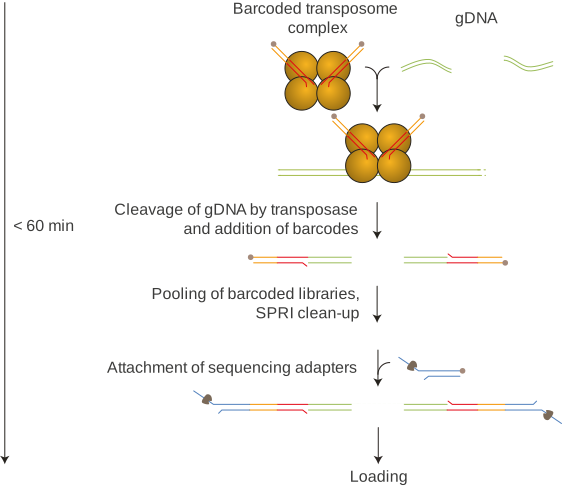
Rapid sequencing DNA V14 - barcoding (SQK-RBK114.24 or SQK-RBK114.96)
Learn how to perform rapid genomic DNA barcoding using the Rapid Barcoding Kit V14 (SQK‑RBK114.24 / SQK‑RBK114.96). This fast, high‑yield library preparation workflow enables multiplexing of up to 96 gDNA samples with ~60‑minute prep time and compatibility with R10.4.1 flow cells.
Ligation sequencing DNA V14 (SQK-LSK114)
This protocol describes how to carry out sequencing of a DNA sample using the Ligation Sequencing Kit V14 (SQK-LSK114). It is recommended that a Lambda control experiment is completed first to become familiar with the technology.
Ligation sequencing gDNA - Native Barcoding Kit 24 V14 (SQK-NBD114.24)
This protocol describes how to carry out native barcoding of genomic DNA (gDNA) using the Native Barcoding Kit 24 V14 (SQK-NBD114.24).
Ligation sequencing gDNA - Native Barcoding Kit 96 V14 (SQK-NBD114.96)
This document describes the barcoding of native genomic DNA libraries.
For Research Use Only
Analysis workflows
Latest research
:quality(80))
Exploring the methylation dimension
Watch this webinar to learn more about leveraging Oxford Nanopore gold standard methylation sequencing in your research.
:quality(80))
Decoding the Peruvian Amazon with in situ DNA barcoding of vertebrate and plant taxa
Publication: Decoding the Peruvian Amazon with in situ DNA barcoding of vertebrate and plant taxa
:quality(80))
Barcode 100K specimens: in a single nanopore run
Publication: Barcode 100K specimens: in a single nanopore run
:quality(80))
Borg extrachromosomal elements of methane-oxidizing archaea have conserved and expressed genetic repertoires
:quality(80))
Borg extrachromosomal elements of methane-oxidizing archaea have conserved and expressed genetic repertoires
Publications: Borg extrachromosomal elements of methane-oxidizing archaea have conserved and expressed genetic repertoires