Genomic DNA extraction from human blood using the Qiagen Puregene kit


Extraction Method
Genomic DNA extraction from human blood using the Qiagen Puregene kit
FOR RESEARCH USE ONLY.
Contents
Introduction
Materials
Method
Change log
Introduction
This protocol describes a method to extract genomic DNA from human blood samples using the Puregene® Blood Kit from Qiagen.
Materials
- ≥ 1 ml of fresh human blood in EDTA K2 vacuum tube
Consumables
- Puregene Blood Kit (Qiagen, 158023)
- Isopropanol, 100% (Fisher Scientific, 10723124)
- Freshly prepared 80% ethanol in nuclease-free water
- TE buffer (10 mM Tris-HCl, 1 mM EDTA, pH 8.0) (Fisher Scientific, 10224683)
- Nuclease-free water (e.g. Thermo Scientific, AM9937)
- Absorbent material e.g. paper towel or tissues
- Qubit™ dsDNA BR Assay Kit (Invitrogen, Q32850)
- Qubit™ Assay Tubes (Invitrogen, Q32856)
- 15 ml Falcon tubes
- 1.5 ml Eppendorf DNA LoBind tubes
Optional consumable:
- Genomic DNA 165 kb Analysis Kit (Agilent, FP-1002-0275)
Equipment
- Centrifuge and rotor suitable for 15 ml Falcon tubes
- Incubator or water bath set at 37°C and 50°C
- Vortex mixer
- Microfuge
- Qubit™ fluorometer (or equivalent for QC check)
- Ice bucket with ice
- Timer
- Wide-bore pipette tips
- P1000 pipette and tips
- P200 pipette and tips
- P20 pipette and tips
- P10 pipette and tips
- P2 pipette and tips
Optional equipment:
- Agilent Femto Pulse System (or equivalent for read length QC)
Method
Genomic DNA extraction
1. Dispense 3 ml of RBC Lysis Solution into a 15 ml Falcon tube.
2. Ensure the blood is mixed well in the EDTA K2 tube, then transfer 1 ml of the blood sample into the tube containing the RBC Lysis Solution.
3. Mix by inverting the tube 10 times.
4. Incubate for 5 minutes at room temperature (15–25°C). Invert at least once during the incubation.
5. Centrifuge for 2 minutes at 2,000 x g to pellet the white blood cells.
6. Carefully discard the supernatant, ensuring you leave approximately 200 µl of the residual liquid and the white blood cell pellet.
The supernatant can be removed by pipetting or by pouring the volume out onto an absorbent material.
7. Gently flick the tube and/or pipette mix using a wide bore tip to resuspend the pellet in the residual liquid.
The pellet should be completely dispersed. This facilitates the cell lysis in the next step.
8. Add 3 ml of Cell Lysis Solution.
Pipette mix gently 10–15 times to lyse the cells and homogenise the solution until no clumps remain. Make sure that the solution is homogenous.
9. Incubate the reaction at 37°C for 30 minutes.
Make sure the solution is homogenous by the end of the incubation and no clumps remain.
If necessary, pipette mix the reaction using a wide bore pipette tip or gently invert the tube to assist with homogenisation.
10. Add 15 μl of RNase A solution and incubate the reaction for 15 minutes at 37°C.
11. Transfer the reaction to an ice bucket with ice and incubate for 3 minutes to quickly cool the sample.
12. Add 1 ml of Protein Precipitation Solution to your sample. Pulse vortex the tube twice for 5 seconds.
13. Centrifuge your sample for 5 minutes at 2,000 x g.
The precipitated protein should form a tight, reddish-brown pellet. If the protein pellet is not tight, incubate the tube on ice for 5 minutes and repeat the centrifugation.
14. Pipette 3 ml of isopropanol into a clean 15 ml Falcon tube.
15. Carefully pour the supernatant from the sample tube into the 15 ml Falcon tube containing the isopropanol.
Make sure that the protein pellet is not dislodged during pouring.
Alternatively, the supernatant can also be transferred by pipetting. Make sure that the protein pellet is not disturbed and remains intact when transferring the supernatant.
Note: If at any point the protein pellet is disturbed, repeat the 2,000 x g centrifugation step for 10 minutes. Make sure only the clear supernatant is transferred to avoid protein contamination in the final eluate.
16. Gently mix the tube by inverting 50 times, until the DNA is visible as threads or a clump.
17. Centrifuge the tube for 3 minutes at 2,000 x g.
Your DNA should be visible as a small white pellet at the bottom of the tube.
18. Carefully discard the supernatant and drain the tube by inverting it onto a clean piece of absorbent paper. Ensure the DNA pellet is undisturbed and remains in the tube.
The supernatant can be removed by pipetting or by pouring the volume out onto an absorbent material. Take care as the pellet might be loose and easily dislodged.
19. Prepare 300 µl of fresh 80% ethanol in nuclease-free water and place on ice.
20. Add 300 μl of ice-cold freshly-prepared 80% ethanol to the sample tube. Gently invert the tube several times to wash the DNA pellet.
21. Transfer the pellet and the full 300 μl volume of ethanol into a new 1.5 ml Eppendorf tube.
22. Centrifuge the sample tube for 1 minute at 2,000 x g.
23. Carefully discard the supernatant and drain the tube by inverting onto a clean piece of absorbent paper. Ensure the DNA pellet is undisturbed and remains in the tube.
The supernatant can be removed by pipetting or by pouring the volume out onto an absorbent material. Take care as the pellet might be loose and easily dislodged.
24. Leave the lid off the sample tube and air dry the pellet for 1 minute.
Avoid over-drying the pellet. Make sure it is not dried to the point of cracking.
25. Add 100 μl of TE buffer (10 mM Tris-HCl, 1 mM EDTA, pH 8.0) to the tube containing the sample pellet. Gently resuspend the pellet by flicking.
26. Incubate the tube for 2 hours at 50°C, occasionally pipette mixing the whole volume in the tube (100 μl) with a wide-bore pipette tip.
The DNA pellet may take some time to solubilise. Make sure that the solution is homogenous before quantifying.
Optional: Alternatively, this incubation can be performed at room temperature overnight.
DNA quantification
- Quantify your sample three times using the Qubit dsDNA BR Assay Kit. Ensure the replicate Qubit measurements are consistent before continuing to the next step.
Approximately 10–30 µg of gDNA is expected following sample extraction.
The expected Qubit measurements should be 100–300 ng/μl.
- If your Qubit measurements are not consistent, this could indicate that the DNA has not been homogeneously resuspended.
If this occurs, we recommend increasing the incubation time, allowing more time for the DNA pellet to solubilise.
Note: The elution can be aided by incubating at 50°C on a thermomixer with gentle agitation at 300 rpm. Alternatively an end-over-end rotating mixer can be used.
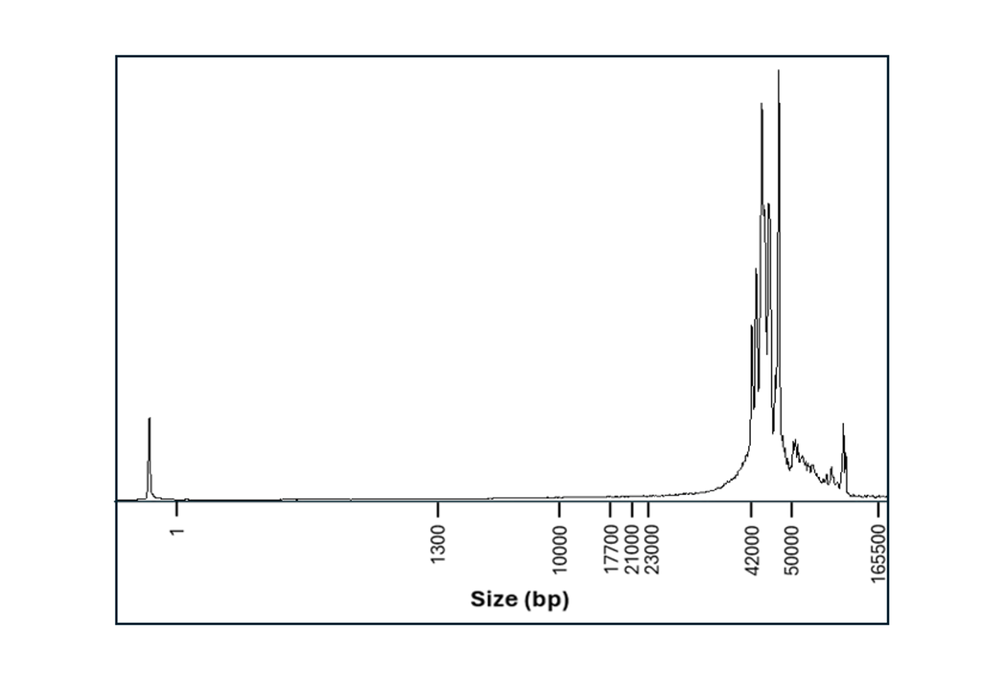
- Your extracted gDNA can also be analysed using Femto Pulse (Agilent) to check the size and quality.
Example of a fragment length profile of gDNA extracted from human blood using the Puregene Blood Kit is shown below:
Change log
| Date | Version | Changes made |
|---|---|---|
| 11 Nov 2026 | v1 | Initial document publication |