Analysis of scalable DNA extraction using the Promega Maxwell RSC for human blood, saliva and buccal swab processing


Extraction Method
Analysis of scalable DNA extraction using the Promega Maxwell RSC for human blood, saliva and buccal swab processing
FOR RESEARCH USE ONLY.
Contents
Introduction
Platform
Sample preparation and sequencing
Results
Performance summary across tissue types
Change log
Introduction
Advances in nanopore sequencing have significantly expanded opportunities for high-throughput genomic analysis across a wide range of sample types. However, achieving consistent, high-quality sequencing performance at scale requires robust and scalable upstream workflows, particularly for DNA extraction. In this study, we evaluated the Maxwell RSC extraction platform from Promega for its compatibility with Oxford Nanopore Technologies sequencing. Using blood, saliva, and buccal swab samples, we assessed the platform performance in terms of DNA yield, fragment lengths, read lengths, and output using LSK and HTB workflows.
Platform
Sample preparation and sequencing
To evaluate the performance of the Maxwell RSC, we used three biological sample types: blood, saliva, and buccal swab as test material. For blood, four different donor samples were used. Samples were shipped overnight at 4°C and processed immediately upon receipt. For saliva and buccal swab, ten donor samples of each type were collected for evaluation. Saliva was collected in 1 ml Genefix DNA collection and stabilisation tubes (GFX-01, Isohelix), while buccal swabs were obtained using Isohelix SK-1S DNA/RNA Buccal Swabs and stabilised with Isohelix Dri-Capsules (SGC-50).
DNA extractions were performed according to the manufacturer’s instructions specific to each kit, as detailed in Table 1 in section 4. Extracted gDNA was quantified using the Qubit dsDNA BR Kit (Thermo Fisher), and fragment lengths assessed using the Femto Pulse system (Agilent).
For blood and saliva samples, pilot experiments were performed to determine optimal fragmentation conditions using the GenoGrinder system (data not shown). Fragmentation of 3 μg of DNA for blood and 1 μg of DNA for saliva, in 60 μl volume for 5 minutes at 1,600 SPM yielded the best balance between read length and flow cell output, and this condition was subsequently used in library preparation for these sample types. Swab-derived gDNA did not require fragmentation due to its inherently shorter fragment lengths.
Library preparation was conducted using the Ligation Sequencing Kit (SQK-LSK114) protocol (LSK) for all sample types, where replicates represent different biological samples. For blood samples, libraries were also prepared using the Native Barcoding Kit (SQK-NBD114.24) using an alternative protocol intended for high-throughput barcoding (HTB) that utilises 3 Ampure XP bead washes during prep. In the HTB method, replicates represent the same library split across three flow cells (not biological replicates). All sequencing was performed on PromethION R10.4.1 Flow Cells for 72 hours. A single flow cell wash was conducted at approximately 36 hours for the blood libraries. No wash was necessary for saliva or swab libraries due to the shorter read lengths. Fragment distributions, read length profiles, and flow cell outputs are reported for blood in Figure 1, for saliva in Figure 2, and for buccal swabs in Figure 3.
Results
Blood
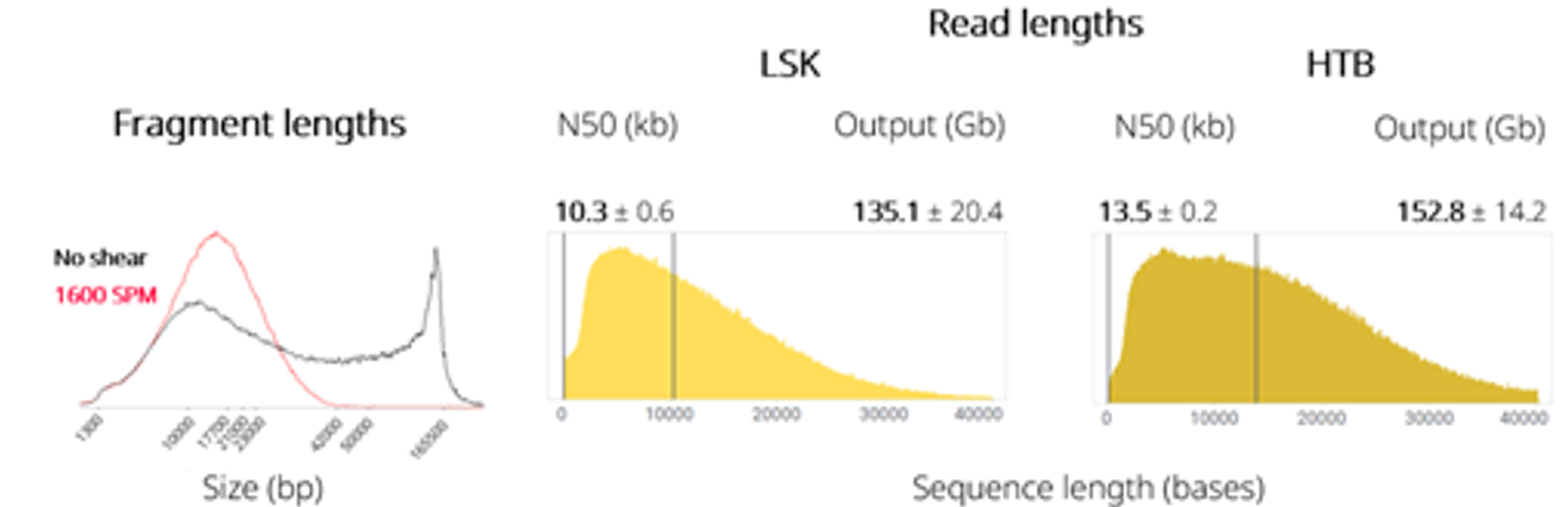
Figure 1. Fragment, read length and sequence output performance for the Promega Maxwell RSC extraction platform using blood as the sample type. The platform generates high molecular weight (HMW) DNA. The ‘no shear’ gDNA also exhibits a ~10 kb ‘hump’ which corresponds to a shorter read length N50 of approximately 12 kb.
Saliva
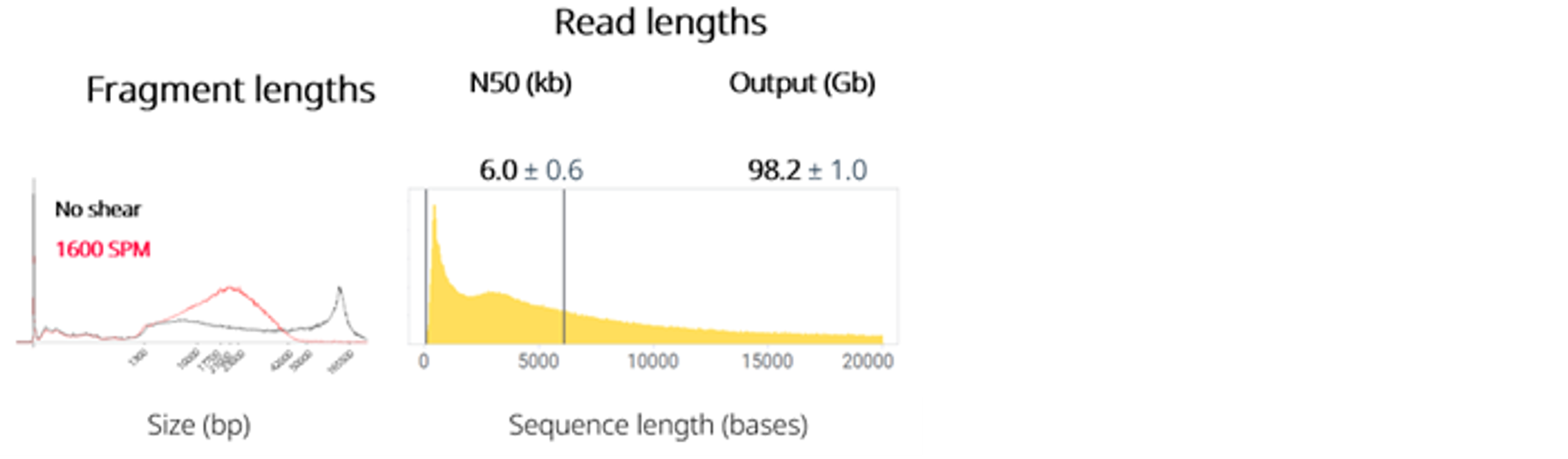
Figure 2. Fragment, read length and sequence output performance for the Promega Maxwell RSC extraction platform tested using saliva as the sample type. This sample type demonstrates high sample-to-sample variation in extraction yield (2.6 ± 2.4 μg) demonstrating ~20% sample ‘dropout’ where yields were occasionally too low (<1 μg) for continued library preparation. This platform produced fragmented extractions with short read lengths.
Buccal swab
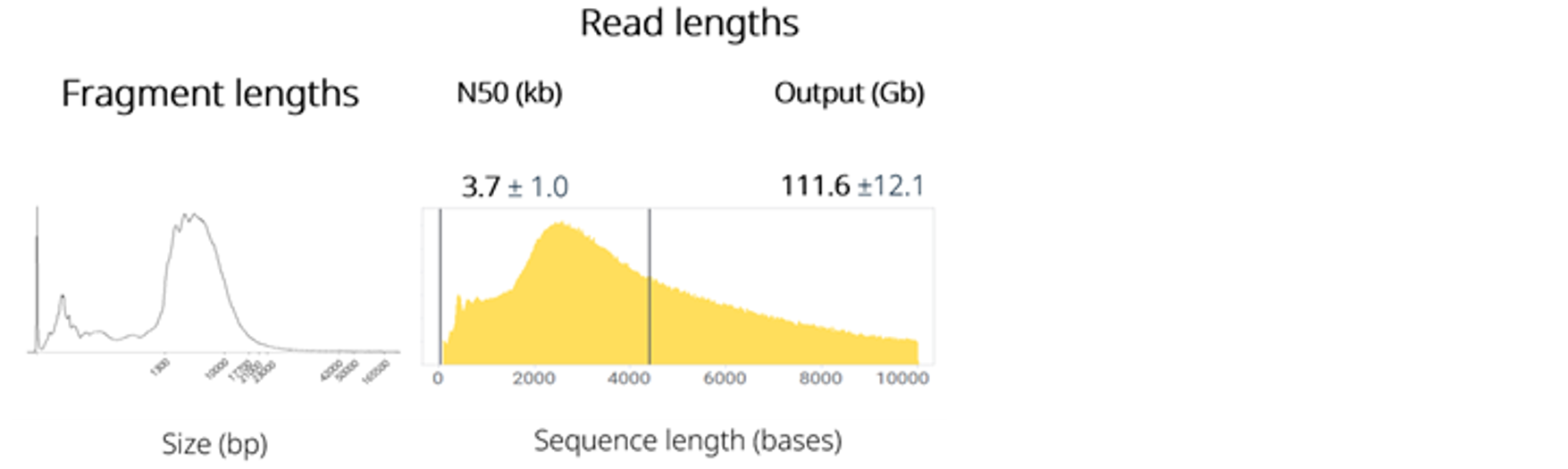
Figure 3. Fragment, read length and sequence output performance for the Promega Maxwell RSC extraction platform tested using buccal swabs as the sample type. This sample type naturally provides both a low-yielding extraction and a highly fragmented DNA profile. A high sequence output (111.6 Gb) was produced from this platform.
Summary Tables
Summary Tables showing the information for each sample type for extraction, library preparation, and sequencing.
Extractions
| Sample type | Kit | Tissue input (µg) | Avg yield (µg) | Fragmentation (GenoGrinder) |
|---|---|---|---|---|
| Blood | Whole Blood DNA Kit | 500 | 6.2 ± 2.1 | 3 µg, 60 µl, 1,600 SPM for 5 min |
| Saliva | RCS Stabilised Saliva DNA Kit | 1,000 | 2.6 ± 2.4 | 1 µg, 60 µl, 1,600 SPM for 5 min |
| Buccal swab | RCS Genomic DNA Kit | 400 | 2.4 ± 2.4 | - |
Table 1. Extraction for each sample type showing the extraction kit used, tissue input, and average yield.
Library preparations
| Sample type | Prep input | Input (µg) | Avg final recovery (%) | Avg ng per QC load | Avg ng per load |
|---|---|---|---|---|---|
| Blood | LSK HTB | 2.4 3 | 48 33 | N/A 453 | 576 214 |
| Saliva | LSK | 1 | 26 | 266 | |
| Buccal swab | LSK | 1 | 27 | 271 |
Table 2. Library preparation for each sample type showing the sequencing kit used, DNA input, average recovery following library preparation, and average load on the flow cell.
Sequencing metrics
| Sample type | Prep input | Avg sequence output (Gb) | Avg read N50 (kb) | Avg pore counts (k) |
|---|---|---|---|---|
| Blood | LSK HTB | 135.1 ± 20.4 152.8 ±14.2 | 10.3 ± 0.6 13.5 ± 0.2 | 6.1 ± 1.1 6.7 ± 0.6 |
| Saliva | LSK | 98.2 ± 1.0 | 6.0 ± 0.6 | 6.7 ± 0.7 |
| Buccal swab | LSK | 111.6 ± 12.1 | 4.0 ± 1.5 | 6.5 ± 0.9 |
Table 3. Sequencing metrics for each sample type showing the average sequence output, read N50 and pore counts.
Performance summary across tissue types
Tissue type: Blood (LSK & HTB)
The Maxwell RSC produced high outputs (135.1 ± 20.4 Gb with LSK and 152.8 ± 14.2 Gb with HTB) with read lengths (10.3 ± 0.6 kb with LSK and 13.5 ± 0.2 kb with HTB). The average extraction yield exceeded the requirement for downstream library preparation (>3 ug).
Tissue type: Saliva (LSK)
The sequencing output for this sample type was ~100 Gb with a long read N50 of 6.0 ± 0.6 kb.
Tissue type: Buccal swab (LSK)
This platform performed well with a read N50 (4.0 ± 1.5 kb) and a high sequencing output (111.6 ± 12.1 Gb).
Change log
| Date | Version | Change |
|---|---|---|
| Jun 2026 | v1 | Initial publication |