Science Unlocked: publication picks from October 2026
In this monthly series, we share a selection of recent publications that use Oxford Nanopore sequencing to unlock novel insights. Spanning paediatric cancer profiling, plasmid sequencing, and gene therapy research, these studies showcase the advances in scientific research made possible by Oxford Nanopore technology.
Featured in this edition:
1. Targeted sequencing with digital panels cut cost and time needed for tumour characterisation
2. Nanopore sequencing identifies vector fragment behind AAV gene therapy adverse event
3. Any-length reads support repeat expansion characterisation
4. New insights into the drivers of Lyme disease virulence
Cancer research
1. Accelerated and comprehensive paediatric cancer profiling using whole-genome sequencing with Adaptive Sampling (Genome Medicine)
Characterising tumours is key for clinical decision-making, but current methods can be slow and resource intensive. Geoffrion et al. explored whether on-device, real-time targeted nanopore sequencing of digital panels’ of target regions, powered by Adaptive Sampling, could in time, and with validation, deliver comprehensive molecular characterisation in a single sequencing run1. The researchers detected genomic variants and methylation within 72 hours of sequencing, reducing the time to answer and lowering cost compared with tumour profiling using a range of techniques (approximately $1,700 Canadian dollars compared with more than $5,000).
‘High-coverage [whole-genome sequencing with Adaptive Sampling] enables the detection of the full spectrum of clonal and subclonal alterations in paediatric cancers through a single, rapid and integrated assay’
Geoffrion, N. et al.1
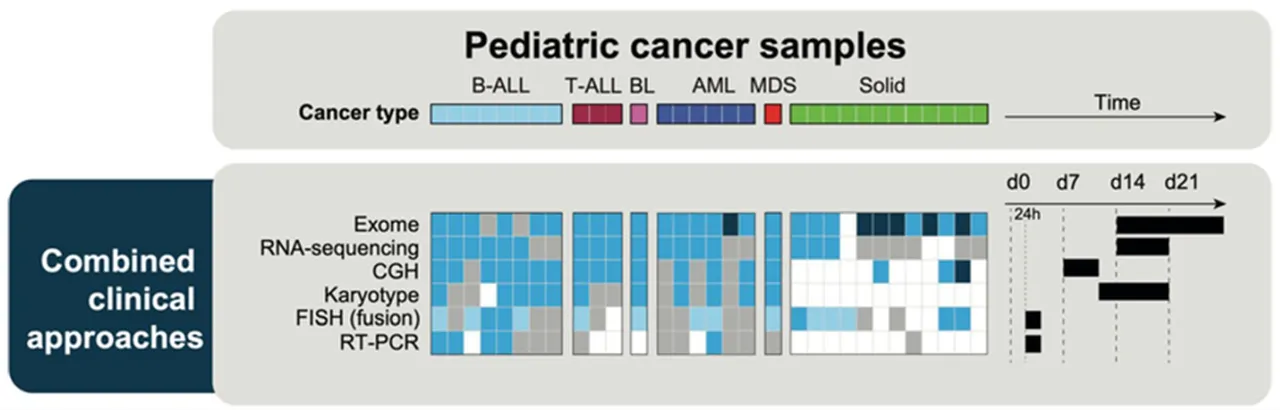
Figure 1. Real-time targeted nanopore sequencing with Adaptive Sampling characterised the alterations identified by a combination of established clinical testing methods in 87% of research samples (dark blue cells), including all clinically relevant alterations, demonstrating its potential for near-real-time tumour characterisation. Figure adapted from Geoffrion et al.1 and available under CC-BY 4.0.
Learn how you could apply digital panels to your research questions in our getting started guide.
Biopharma
2. Integration-associated paraspinal neoplasm after AAV gene therapy (New England Journal of Medicine)
In a study by Vo et al., the authors described a case in which a patient received adeno-associated virus (AAV) gene therapy and then developed a paraspinal neoplasm2. Whilst targeted sequencing could not detect the oncogenic mutation or fusion in a research sample from the neoplasm, a protocol they developed using nanopore sequencing identified a 1,038 bp integrated AAV vector fragment that was driving aberrant GLI1 expression. The authors suggested that these findings highlight the need for extended genomic surveillance after AAV gene therapy.
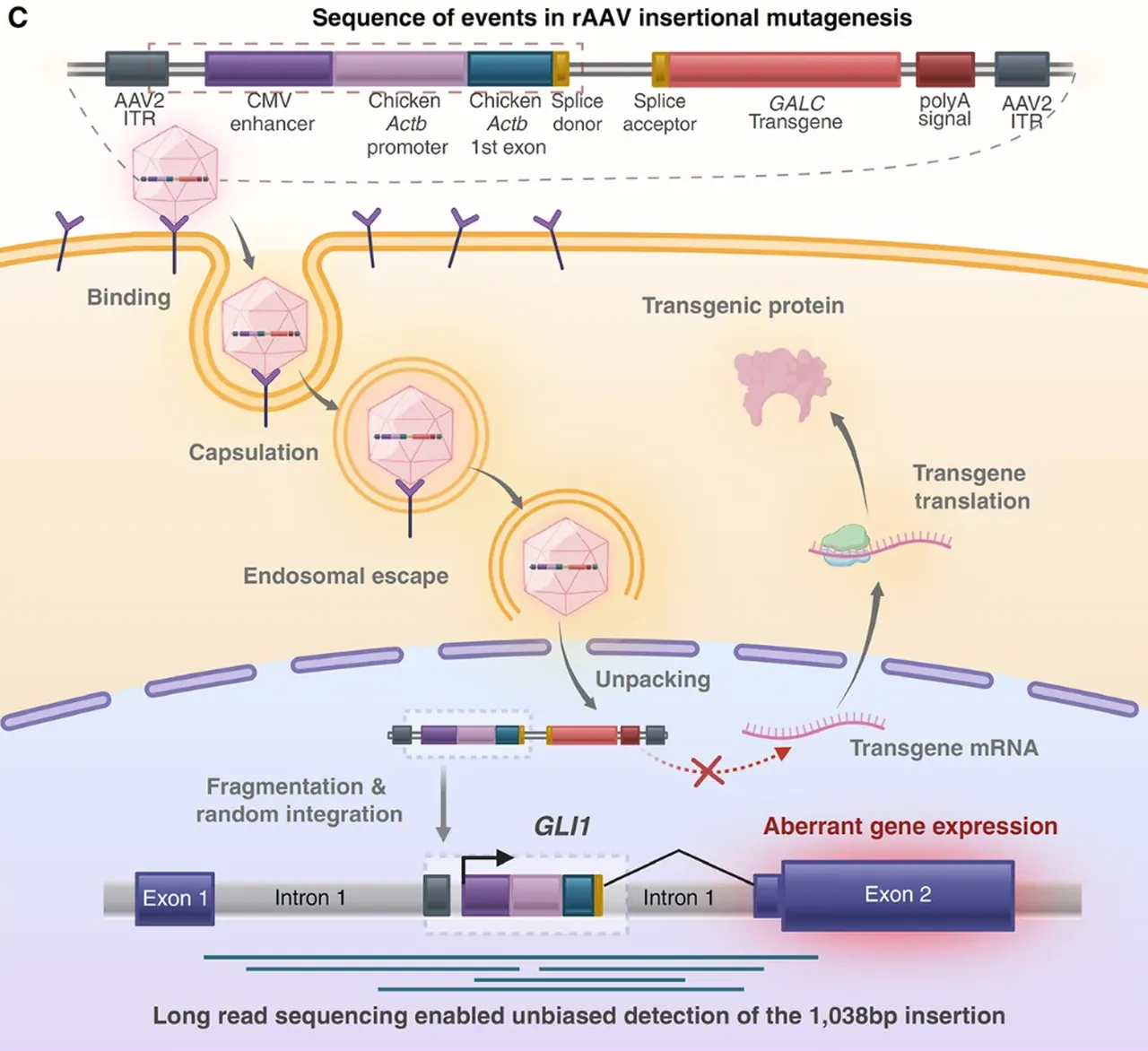
Figure 2. Long-read sequencing detected a subgenomic vector fragment that integrated into GLI1 intron 1 and spliced to exon 2, driving aberrant GLI1 expression. Figure adapted from Vo et al.2 and available under CC-BY 4.0.
AAV vectors are predominantly non-integrating and have an established safety record across thousands of recipients3. At the London Calling 2026 conference, Stefan Hardy Lung (Institute of Virology Innsbruck, Austria), presented his nanopore-sequencing-based method for AAV characterisation and quality control.
Discover our best-practice sequencing workflow for AAV vector quality control in this workflow overview.
Human genetics
3. Nanopore sequencing combined with Adaptive Sampling and NanoExpansion enables accurate characterisation of repeat expansion disorders (NAR Genomics and Bioinformatics)
In this research study, targeted nanopore sequencing of a digital panel — powered by Adaptive Sampling — characterised repeat expansions in research samples from 132 participants, resolving expansion size, mosaicism, and interruption patterns4. The authors detected expansions across multiple neurological disorders, while their NanoExpansion tool reconstructed repeat architecture and methylation. Long-range PCR and short-read sequencing-based approaches were less informative for large expansions, highlighting the value of amplification-free any-length nanopore reads.
‘[Oxford Nanopore] sequencing coupled with [Adaptive Sampling] is crucial in designing an advanced diagnostic tool for [repeat expansion disorders].’
Morandi, L. et al.4
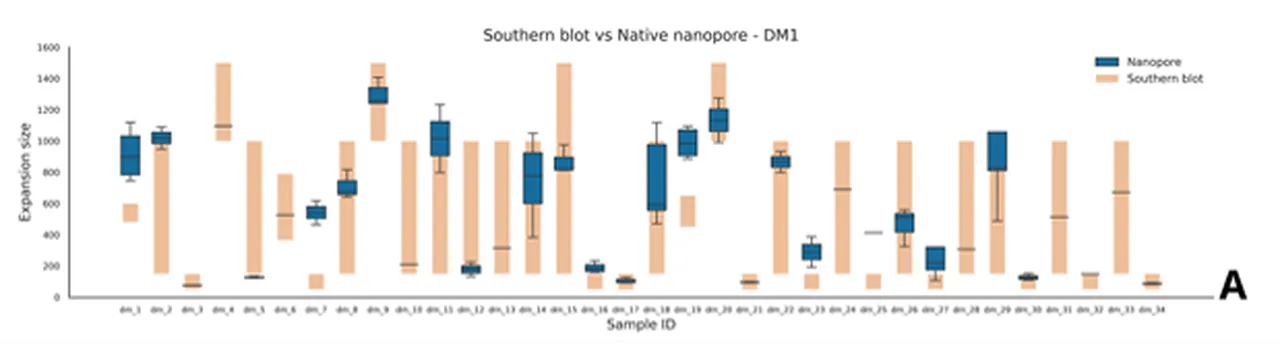
Figure 3. Estimated repeat expansion lengths in data from research samples from individuals with myotonic dystrophy type 1 (DM1). Nanopore sequencing was concordant with Southern blot for all but six research samples, and provided more accurate short tandem repeat length estimations. Figure adapted from Morandi et al.4 and available under CC-BY 4.0.
Repeat expansions are associated with over 50 rare diseases5. With Mahi-mahi, our analysis tool designed for Oxford Nanopore reads, you can capture and phase repeat expansion lengths, motifs, sequence interruptions, and methylation from research samples in a single assay.
Infectious disease
4. Linkage blocks involving multiple replicons organise Borrelia burgdorferi strain variation and influence virulence in Lyme disease (bioRxiv)
The bacterium Borrelia burgdorferi, responsible for Lyme disease, contains many homologous plasmids that short-read sequencing technology struggles to resolve. Laing et al. used unrestricted nanopore read lengths to generate long-read assemblies (LRAs), complemented by separate PacBio assemblies, enabling near-complete B. burgdorferi genome analysis6. The researchers uncovered gene modules spanning plasmids and the chromosome, some of which are associated with human dissemination, opening a clearer path to investigating the genetic basis of Lyme disease virulence.
‘LRAs provide a more complete picture of [Borrelia burgdorferi] genomes and population structure than has been previously available from short read analyses.’
Laing, R. A. et al.6
Discover how to perform on-demand sequencing of full-length plasmids in your own lab with Oxford Nanopore technology using our complete sample-to-answer workflow.
Apply Oxford Nanopore sequencing to your own research questions and you’ll never see sequencing the same way again. Explore the nanopore sequencing solution.
Oxford Nanopore Technologies products are RUO. Products labelled/branded as OND may be RUO or may be regulated as in-vitro diagnostic devices in some jurisdictions.
- Geoffrion, N. et al. Accelerated and comprehensive pediatric cancer profiling using whole-genome sequencing with adaptive sampling. Genome Med. (2026) DOI: https://doi.org/10.1186/s13073–026-01815-7
- Vo, J.N. et al. Integration-associated paraspinal neoplasm after AAV gene therapy. https://pmc.ncbi.nlm.nih.gov/articles/PMC13671263/ (2026) [Accessed 10 November 2026]
- Byrne, B.J. et al. Current clinical applications of AAV-mediated gene therapy. Mol. Ther. 33(6):2479–2516 (2025). DOI: https://doi.org/10.1016/j.ymthe.2025.04.045
- Morandi, L. et al. Nanopore sequencing combined with adaptive sampling and NanoExpansion enables accurate characterization of repeat expansion disorders. NAR Genom. Bioinform. 8(4):lqag117 (2026). DOI: https://doi.org/10.1093/nargab/lqag117
- Chen, Z. et al. Repeat expansion disorders. Pract. Neurol. 25(3):204–216 (2025). DOI: https://doi.org/10.1136/pn-2023-003938
- Laing, R. A. et al. Linkage blocks involving multiple replicons organize Borrelia burgdorferi strain variation and influence virulence in Lyme disease. bioRxiv 635312 (2025). DOI: https://doi.org/10.1101/2025.01.29.635312
- Published on: November 18 2026