Microbiome
Getting started guides
:quality(80))
A guide to microbial sequencing with Oxford Nanopore
A guide to get started with sequencing microbial samples with Oxford Nanopore.
Most viewed
:quality(80))
Oxford Nanopore sequencing solutions for microbiology and infectious disease research
In this brochure, discover Oxford Nanopore sequencing techniques that can reveal multidimensional insights for your microbial research applications.
:quality(80))
Oxford Nanopore sequencing provides superior metagenome-assembled genome recovery and strain-level resolution from a complex microbiome
In this application note, we demonstrate the
capabilities of Oxford Nanopore metagenomics by
sequencing and analysing the well-characterised
ZymoBIOMICS Fecal Reference.
:quality(80))
GridION: one sequencer for many
Made with multiple projects and teams in mind, GridION gives you the freedom to start, stop, and scale your sequencing experiments without impacting others. Meanwhile, onboard compute keeps your real-time data optimised. Discover more.
:quality(80))
MinION: palm sized, world ready
Discover how the portable yet powerful MinION Mk1D sequencing device can take your insights further afield. Start generating rapid, real-time results without compromise.
:quality(80))
PromethION 2 Integrated: small box, big picture
Explore the PromethION 2 Integrated and bring high-output Oxford Nanopore sequencing to your lab. Run up to two independent flow cells with onboard compute for real-time insights. Discover more.
Workflow overviews
:quality(80))
Rapid identification of respiratory pathogens with Oxford Nanopore metagenomics
This end-to-end workflow introduces how to rapidly identify bacterial, fungal, and viral pathogens from respiratory research samples using metagenomic Oxford Nanopore sequencing on a MinION or GridION.
Featured resources
:quality(80))
Genomics for a changing planet: sequencing the living world
Discover how a global community of researchers are harnessing Oxford Nanopore sequencing to study the far-reaching impacts of climate change, revealing deep insights across environmental research, agriculture, and pathogen surveillance.
:quality(80))
Pan-microbial pathogen detection in hours using metagenomic sequencing
In this case study, discover how the UK NHS Respiratory Metagenomics Network have developed a rapid Oxford Nanopore sequencing workflow that can detect the bacteria, viruses, fungi, and parasitic pathogens underlying respiratory infections in a matter of hours.
:quality(80))
Addressing the challenges of metagenomics with Oxford Nanopore sequencing
Explore how reads with unrestricted length are revealing unprecedented insight into microbial communities.
:quality(80))
Wastewater sequencing — an early warning system for infectious disease outbreaks
Monitoring the genomic characteristics of pathogens circulating in a population can reveal important insights into the epidemiological dynamics of an outbreak. Unfortunately, sequencing every confirmed positive sample in a densely populated area is both challenging and expensive. Since viruses are s
:quality(80))
Species-level profiling of environmental microbiota with high-accuracy full-length nanopore 16S sequencing
Rapid bacterial detection plays a vital role in researching microbial ecology. Understanding bacterial composition, diversity, and dynamics is key in the response to pathogen emergence and outbreaks. Sequencing of the 16S ribosomal RNA (rRNA) gene is a predominant method for microbial identification
Protocols
Microbial Amplicon Barcoding Sequencing for 16S and ITS (SQK-MAB114.24)
Step-by-step protocol for microbial 16S and ITS amplicon sequencing using the Oxford Nanopore Microbial Barcoding Kit.
:quality(80))
Nanopore-only Microbial Isolate Sequencing Solution (NO-MISS) from cell cultures using SQK-RBK114 (.24 or .96)
Nanopore-only Microbial Isolate Sequencing Solution (NO-MISS) from cell cultures using SQK-RBK114 (.24 or .96)
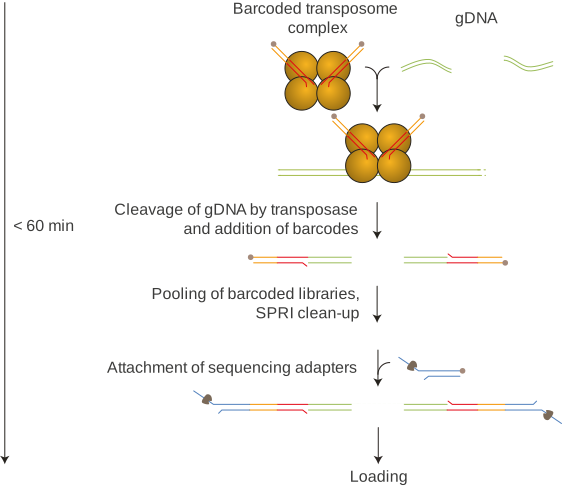
Rapid Sequencing gDNA Barcoding Protocol (SQK-RBK114.24 or SQK-RBK114.96) | Oxford Nanopore Technologies
Learn how to perform rapid genomic DNA barcoding using the Rapid Barcoding Kit V14 (SQK‑RBK114.24 / SQK‑RBK114.96). This fast, high‑yield library preparation workflow enables multiplexing of up to 96 gDNA samples with ~60‑minute prep time and compatibility with R10.4.1 flow cells.
Analysis workflows
Latest research
:quality(80))
Exploring the methylation dimension
Watch this webinar to learn more about leveraging Oxford Nanopore gold standard methylation sequencing in your research.
:quality(80))
Metagenomics and microbial bioinformatics: latest tools and workflow
Learn how to analyse long-read amplicon and metagenomic datasets with the latest bioinformatics tools.
:quality(80))
A route to clinical fungal pathogen sequencing
Join this webinar to learn out about the advantages of targeted ITS and whole-genome sequencing approaches for potential clinical and epidemiological use.
:quality(80))
The MiDAS global genome catalogue: 53,501 long-read MAGs representing all core prokaryotic genera in the global activated sludge microbiome
Authors: Lei Liu, Caitlin Margaret Singleton, Rasmus Hansen Kirkegaard, et al.
:quality(80))
Core lab webinar series: A new 'gold standard' solution for complete plasmid sequencing
Event overview During our second installment of the series, the speakers shared how nanopore sequencing can be used to validate plasmids. Members of the Oxford Nanopore team took us through the protocol for plasmid sequencing using Oxford Nanopore Rapid Barcoding Kits and how to approach an