Metagenomics in action
Every research question starts with uncertainty. Is there a pathogen present? Which microbes matter? Where is antimicrobial resistance emerging? Answering these questions can require multiple methods, adding time and complexity. Metagenomic sequencing offers a more comprehensive approach, revealing the diversity of complex microbial communities in a single experiment, with insights available in real time.
In this Tech Talk with Researchers blog, we hear from scientists using nanopore metagenomics to answer questions on a range of topics, spanning infectious diseases, antimicrobial resistance (AMR), environmental monitoring, and microbiome research. Along the way, we’ll highlight workflows, white papers, and other webinars for you to see what’s possible with nanopore metagenomic sequencing. Plus, at the end, you’ll find our suggested resources to help you get started.
Time-critical infection detection
Kumeren Govender (University of Oxford, UK)
Current approaches to identifying bloodstream infections can take days, meaning patients often wait for precise antibiotic treatment. Kumeren and his team are exploring how nanopore metagenomic sequencing could accelerate this process by analysing positive blood cultures in real time.
Across 273 research samples, the workflow identified pathogens in around three hours and generated AMR predictions up to 20 hours earlier than conventional testing. The study demonstrates how real-time sequencing could support faster pathogen identification than current sequencing methods and the prescription of targeted antimicrobial therapy in the future.
'In conclusion, Oxford Nanopore metagenomics enables rapid, accurate pathogen and resistance profiling, delivering faster results than conventional culture while improving species detection sensitivity'
Govender, K.N. et al.1
Check out this on-demand webinar, where researchers explore real-time metagenomic analysis of respiratory infections — from pneumonia in an intensive care unit to broader pathogen surveillance and public health research.
Strengthening surveillance
Lara Urban (University of Zurich, Switzerland)
Pathogen surveillance is essential for protecting global health, food safety, and antimicrobial stewardship. In Lara’s talk at the London Calling conference 2026, she showcased how nanopore metagenomic sequencing is advancing rapid, culture-independent surveillance of foodborne and clinical pathogens.
By combining nanopore sequencing with AI approaches, her team is exploring how to overcome key challenges in sensitivity, pathogen identification, and AMR tracking — enabling a more comprehensive view of microbial threats.
Watch our knowledge exchange for further information about how to use Oxford Nanopore metagenomics for pathogen surveillance, and download our metagenomic sequencing white paper for more case studies and applications.
Expanding access
Anna Rommerskirchen (Heinrich-Heine University Düsseldorf, Germany)
In Ethiopia, Anna and her team are evaluating nanopore sequencing of cell-free DNA as a potential approach for studying sepsis in resource-limited healthcare settings.
Following hands-on training and the establishment of local sequencing and bioinformatics capabilities, data from the pilot study generated high-quality metagenomic datasets and detected microbial DNA in suspected sepsis cases, including pathogens missed by blood culture.
The project demonstrates how portable sequencing can support local research capacity and infectious disease surveillance. Hear more in Anna’s talk below.
To hear about how nanopore metagenomics has been used in other resource-limited settings, listen to our webinar on building sustainable pathogen genomic surveillance across Africa.
Exploring the microbiome
Mariana Bisarro dos Reis (Barretos Cancer Hospital, Brazil)
Colorectal cancer often develops through gradual changes that can be difficult to detect early. Mariana is exploring whether the faecal microbiome captured in routine screening samples could provide new insights.
Using nanopore 16S sequencing, the team at Barretos Cancer Hospital identified distinct microbial patterns across the adenoma–carcinoma pathway, demonstrating the potential of stool sample analysis as a scalable, non-invasive method for investigating biomarkers in colorectal cancer screening.
Kamil Khanipov (The University of Texas Medical Branch, US)
What if the air around us could help reveal emerging public health threats? Kamil and his team have built the largest nanopore-based airborne metagenomics dataset to date, analysing more than 1,000 air samples collected across the US, from everyday environments to mass gatherings such as the Boston Marathon.
By establishing a nationwide baseline of airborne microbial communities and making the data publicly available, the project lays the groundwork for scalable, community-enabled environmental surveillance.
Hear more about Kamil’s research in his talk at the London Calling conference 2026 below and his studio interview.
Download our application poster for more genomic insights into the biology of complex microbiomes with Oxford Nanopore metagenomic sequencing.
Finding the right resources
If these examples have inspired you to use nanopore sequencing for your own metagenomics project, we have a range of resources to help you get started.
For untargeted pathogen detection and characterisation, we recommend starting with our pathogen metagenomics workflow overview, which outlines the rapid metagenomics protocol. These documents will walk you through the process, from extraction to library preparation with the Rapid PCR Barcoding Kit, to sequencing on a MinION or GridION, to data analysis for all levels of experience using EPI2ME wf-metagenomics.
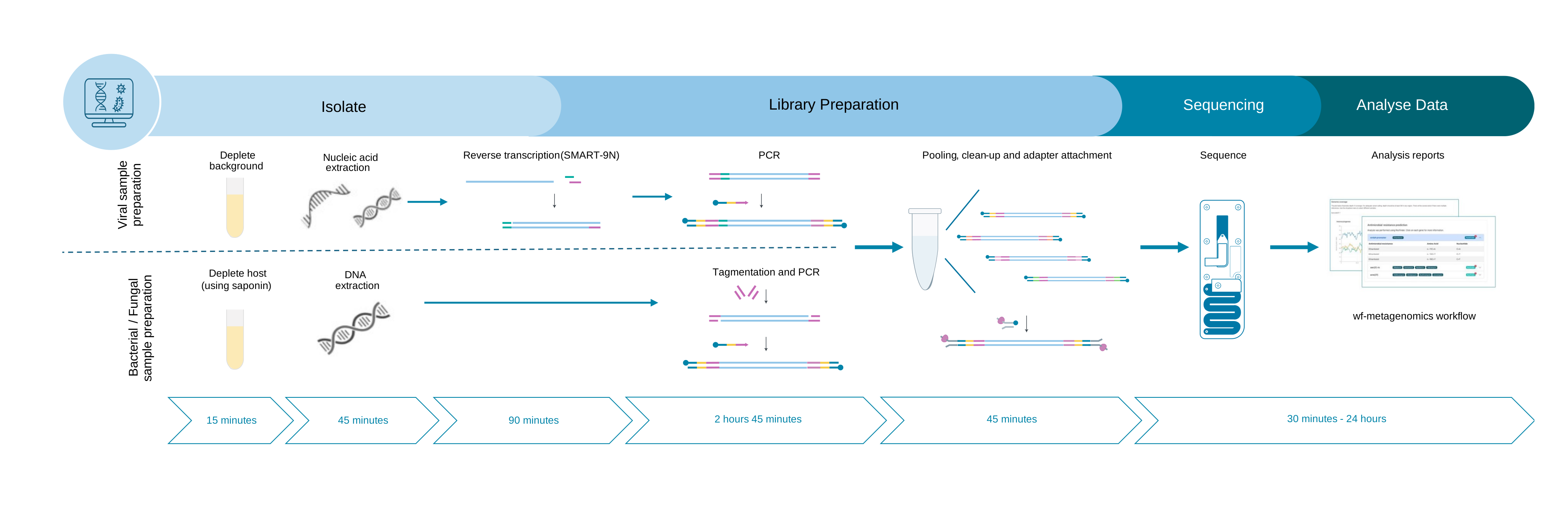
Figure 1. An overview of our end-to-end workflow for rapid metagenomic sequencing for surveillance of bacterial, fungal, and viral pathogens. Figure redistributed from the Oxford Nanopore rapid metagenomics protocol3.
If your goal is targeted microbial profiling, we also have the microbial amplicon barcoding workflow overview, which demonstrates how to streamline bacterial, archaea, and fungi identification using targeted 16S/ITS sequencing.
Not sure which approach best fits your experiment? Our microbial communities masterclass compares different microbial community sequencing strategies and guides on selecting the right workflow for your research question.
Finally, if you want to explore the performance of nanopore metagenomics in more detail, download our metagenomics application note to see how our benchmarking data compares with Illumina short-read and PacBio HiFi long-read data. Plus, find examples of metagenome-assembled genome recovery and strain-level resolution.
If you’ve enjoyed this Tech Talk with Researchers blog, why not try our Real Talk with Researchers series, where we hear from customers on topics such as accuracy, scalability, and the robustness of nanopore data.
Oxford Nanopore Technologies products are not intended for use for health assessment or to diagnose, treat, mitigate, cure, or prevent any disease or condition.
Govender, K.N. et al. Rapid diagnosis of common, undetected, and uncultivable bloodstream infections from positive blood cultures using Oxford Nanopore sequencing: a metagenomic pipeline analysis. Lancet Microbe 7(6):101333 (2026). DOI: https://doi.org/10.1016/j.lanmic.2025.101333
Alcolea-Medina, A. and Snell, L. et al. Rapid pan-microbial metagenomics for pathogen detection and personalised therapy in the intensive care unit: a single-centre prospective observational study. Lancet Microbe 6(10):101174 (2025). DOI: https://doi.org/10.1016/j.lanmic.2025.101174
Oxford Nanopore Technologies. Rapid metagenomic sequencing for surveillance of bacterial, fungal and viral pathogens using SQK-RPB114.24. Available at: https://nanoporetech.com/document/rapid-sequencing-metagenomics-sqk-rpb114-24 [Accessed 01 July 2026]
- Published on: July 22 2026
:quality(80))