Resources
Highlights from London Calling
Discover how researchers are using Oxford Nanopore sequencing to generate new insights across diverse applications.
)
Discover nanopore sequencing
- What it can do
- How it’s being used
- How to get started
Latest protocols
)
Pharmacogenomic (PGx) sequencing workflow with adaptive sampling (blood, cells, saliva)

Telomere-to-telomere sequencing (T2T) from blood and cells using SQK-APK114, SQK-LSK114, and SQK-ULK114
Long read de novo sequencing from blood and cells using SQK-ULK114 – expert telomere-to-telomere method
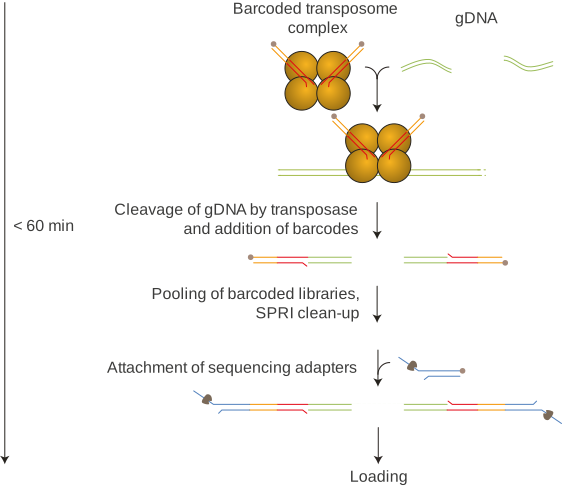
Rapid Sequencing gDNA Barcoding Protocol (SQK‑RBK114) | Oxford Nanopore Technologies
)
Direct RNA sequencing (SQK-RNA004-XL)
Direct RNA sequencing - sequence-specific (SQK-RNA004)
Webinars and events
)
Unlocking high-resolution, strain-resolved microbiome analyses | ASM Microbe 26
During this video we learn how full length Oxford Nanopore sequencing is unlocking high-resolution microbiome analyses
)
Oxford Nanopore at AMP 2026
Oxford Nanopore Technologies are exhibiting and presenting at AMP 2026 in November.
White papers
)
Genomics for a changing planet: sequencing the living world
Discover how a global community of researchers are harnessing Oxford Nanopore sequencing to study the far-reaching impacts of climate change, revealing deep insights across environmental research, agriculture, and pathogen surveillance.
)
New approaches for human and clinical research
Explore the advantages of Oxford Nanopore sequencing to detect genomic and epigenomic variants in human and clinical research.
Case studies
)
Pan-microbial pathogen detection in hours using metagenomic sequencing
In this case study, discover how the UK NHS Respiratory Metagenomics Network have developed a rapid Oxford Nanopore sequencing workflow that can detect the bacteria, viruses, fungi, and parasitic pathogens underlying respiratory infections in a matter of hours.
)
Cell-free DNA sequencing and methylation detection — promising potential for non-invasive cancer monitoring
In this case study, find out how researchers are using nanopore technology to analyse cfDNA for cancer monitoring.
Getting started guides
)
A guide to transcriptomics with Oxford Nanopore
This guide introduces cDNA and direct RNA Oxford Nanopore sequencing, for ultra-rich transcriptomic data without compromise.
)
A guide to microbial sequencing with Oxford Nanopore
A guide to get started with sequencing microbial samples with Oxford Nanopore.
Workflow overviews
Performing accurate species-level bacterial identification with nanopore sequencing
This end-to-end workflow provides a rapid solution for species-level bacterial identification.
)
Sequencing full-length transcripts for isoform-level expression analysis
This end-to-end workflow provides a flexible method to sequence full-length transcripts for isoform-level expression analysis.
Brochures
)
cDNA-PCR Sequencing Kits
In this flyer, discover how you can sequence full-length transcripts and annotate the transcriptome with confidence.
)
Direct RNA Sequencing Kits
In this flyer, discover how you can sequence RNA in its native form. Plus, learn how the new Direct RNA Barcoding Kit unlocks multiplexed sequencing of up to 24 samples in a single run.
)
Browse document repository
Quickly find the resources most relevant to your work. Filter by application, technique, product, or content type to get straight to the content that matters.