Bioinformatics tools
Command-line tools for expert analysis
Access the latest Oxford Nanopore bioinformatics tools and best-practice EPI2ME workflows, with the flexibility to adapt, integrate, and run analysis in your preferred environment.
Command-line EPI2ME workflows
Covering a range of applications, our best-practice EPI2ME analysis workflows give you the flexibility to adapt them to your environment and analysis needs.
Cutting-edge analysis tools
Access our latest generation of command-line analysis tools. Explore tools for basecalling, alignment, methylation analysis, consensus generation, specialised variant calling, and more.
Featured analysis tools
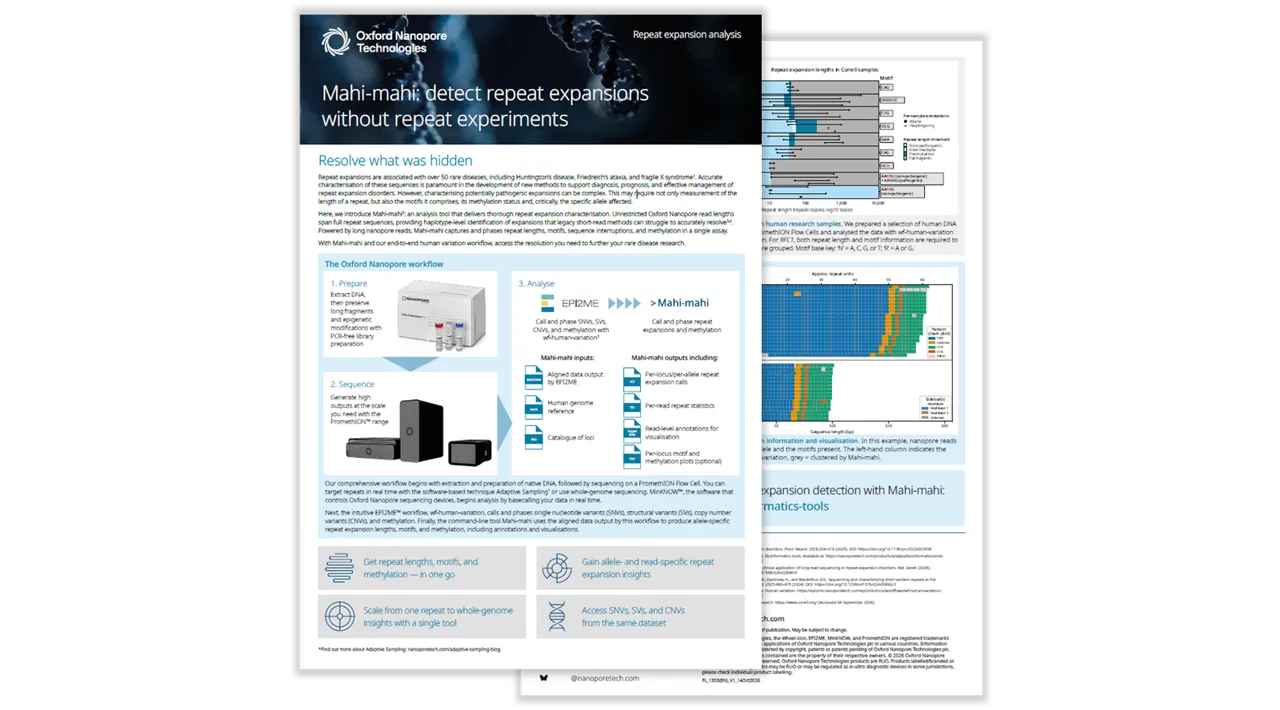
Mahi-mahi: resolve repeat expansions at allele level
Powered by long nanopore sequencing reads, Mahi-mahi captures and phases repeat lengths, motifs, sequence interruptions, and methylation in a single assay. Unrestricted Oxford Nanopore read lengths span full repeat sequences, providing haplotype-level identification of expansions that legacy short-read methods can struggle to accurately resolve.
Dorado: standalone basecalling and beyond
Dorado is integrated into the MinKNOW operating software for all devices and performs functions such as basecalling, alignment, and calling of common DNA and RNA modifications. The standalone, command-line version provides additional features, including read correction, assembly polishing, variant calling, and additional modification calling.
Modkit: analyse base modification data
Oxford Nanopore sequencing of native DNA and RNA enables the identification of modified bases as standard, with no additional library prep or sequencing required. Modkit provides a suite of tools allowing you to analyse this data — from differential methylation detection and haplotype-specific methylation to microbial methylation motif analysis.
wf-human-variation: comprehensive human variation analysis
Available within the EPI2ME desktop app or command-line, the human variation workflow (wf-human-variation) enables direct detection and phasing of single nucleotide variants, structural variants, short tandem repeat expansions, and methylation across the human genome — in one go.
EPI2ME analysis workflows by application
Access and customise a range of pre-configured analysis workflows for integration into your bioinformatics pipelines.
Related information

Datasets
Explore our open-access datasets to test workflows, benchmark performance, and discover richer insights.
Data releases
Short informative articles to help you understand our datasets and how to analyse them.
Compatible interpretation solutions
Discover compatible tertiary analysis solutions from trusted partners for a range of sequencing applications.
FAQs
Do I need command-line experience to use Oxford Nanopore bioinformatics tools?
Command-line experience is recommended for standalone Oxford Nanopore bioinformatics tools and command-line workflows. Users who prefer a graphical interface can access a growing range of preconfigured analysis workflows through EPI2ME Desktop without specialist bioinformatics experience.
What command-line tools are available for analysing Oxford Nanopore sequencing data?
Oxford Nanopore provides a range of command-line bioinformatics tools for processing and analysing nanopore sequencing data. For our latest standalone tools for basecalling, modified-base analysis, consensus generation, variant calling, and more, visit the Oxford Nanopore GitHub page. For best-practice, application-specific analysis workflows, visit the EPI2ME GitHub page.
How do I basecall Oxford Nanopore sequencing data from the command line?
Basecalling, alignment, and more can be performed in real time during sequencing using Dorado, which is integrated into the MinKNOW operating software. For post-run analysis, the standalone, command-line version of Dorado provides additional functionality (including read correction, assembly polishing, and variant calling) and access to the latest analysis algorithms.
Can I analyse DNA and RNA modifications from the command line?
Can I customise Oxford Nanopore bioinformatics workflows?
Yes. EPI2ME workflows are built using Nextflow and are publicly available as command-line workflows, allowing experienced users to inspect, customise, and integrate them into their own bioinformatics pipelines.
Where can I run Oxford Nanopore command-line analysis workflows?
Oxford Nanopore analysis workflows can be run across a range of compute environments, including local systems, compute clusters, and cloud environments. Some EPI2ME analysis workflows can also be run directly on Oxford Nanopore sequencing devices with onboard compute using the EPI2ME Desktop application.
What file formats are used for Oxford Nanopore bioinformatics analysis?
Oxford Nanopore analysis tools work with standard and nanopore-specific sequencing data formats at different stages of analysis, including POD5 for raw signal data and BAM, CRAM, FASTQ, FASTA, VCF, and bedMethyl for processed and downstream data. Find out more about Oxford Nanopore file formats.


