How basecalling works
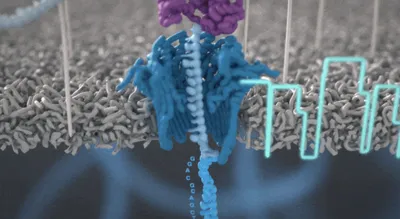
Basecalling interprets raw sequencing data to determine the nucleotide sequence. In Oxford Nanopore sequencing, a voltage applied across a membrane containing nanopores creates an ionic current through each pore. As a DNA or RNA molecule moves through a nanopore, it causes measurable and characteristic changes in the ionic current. These changes are interpreted in real time by basecalling algorithms to generate the nucleotide sequence. And because nanopore sequencing can analyse native DNA and RNA directly, without amplification, base modifications such as methylation are preserved and can be called alongside the nucleotide sequence in one go.
Capturing the signal
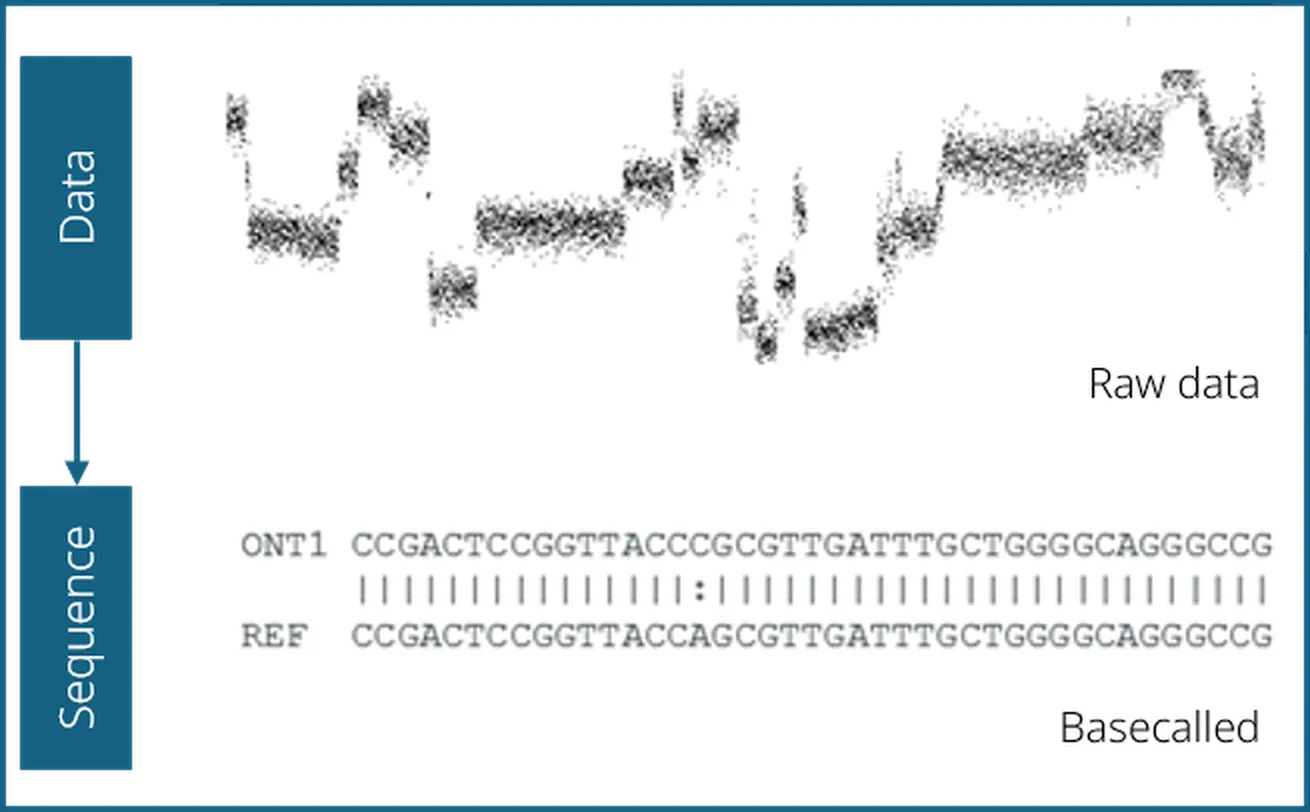
The changes in ionic current produced as DNA or RNA molecules pass through a nanopore are recorded by MinKNOW, the sequencing software that controls all Oxford Nanopore devices. This electrical signal, often referred to as a ‘squiggle’, is interpreted in real time by Dorado, the basecaller integrated into MinKNOW, to generate the nucleotide sequence. Raw nanopore sequencing data can optionally be saved in the POD5 file format, allowing it to be rebasecalled as new models are developed.
Improving the signal
Basecalling accuracy depends on both the algorithm interpreting the signal and the quality of the signal itself. We continue to refine nanopore design, increasing the information contained in the signal and improving how accurately the basecaller calls it.
Nanopores contain a narrow constriction called the ‘reader’. Previous nanopore designs for DNA sequencing had a single reader, whereas the current R10 nanopore has two readers spaced along the pore, allowing more bases to contribute to the squiggle at any one time. This has improved the capture of signals around homopolymer regions, where the same nucleotide is repeated consecutively.
Basecallers: turning signal to sequence
Basecalling algorithms process the raw signal to decode the nucleotide sequence of DNA or RNA strands, with the resulting data stored in BAM or FASTQ files, alongside associated quality information. BAM files can also store base modification data.
Dorado, the basecaller integrated within MinKNOW, can perform basecalling during or after sequencing, depending on your experimental needs. If you basecall during the run, you can assess data as it is generated, make decisions during sequencing, and stop once sufficient data has been collected. Plus, real-time basecalling supports applications such as pathogen identification, where time to result is paramount, and powers Adaptive Sampling, our unique on-device targeted sequencing approach that removes the need for wet-lab amplicon- or probe-based enrichment.
New basecallers and base modification models are first released on the Oxford Nanopore GitHub, letting you access the latest developments, share feedback, and help shape future improvements before we incorporate them into MinKNOW.
Improving basecalling with machine learning
Our current basecalling algorithms are based on neural networks — a type of machine learning model. These computational neural networks are loosely based on biological neural networks within the human brain, with layers of ‘nodes’ (equivalent to neurons) passing data between themselves to arrive at a predicted nucleotide sequence. Crucially, just like the human brain, these neural networks can learn and improve their predictions over time, leading to the development and release of better basecalling models.
We use a range of neural network architectures, including transformer models and recurrent neural networks, to balance accuracy, speed, and computational requirements.
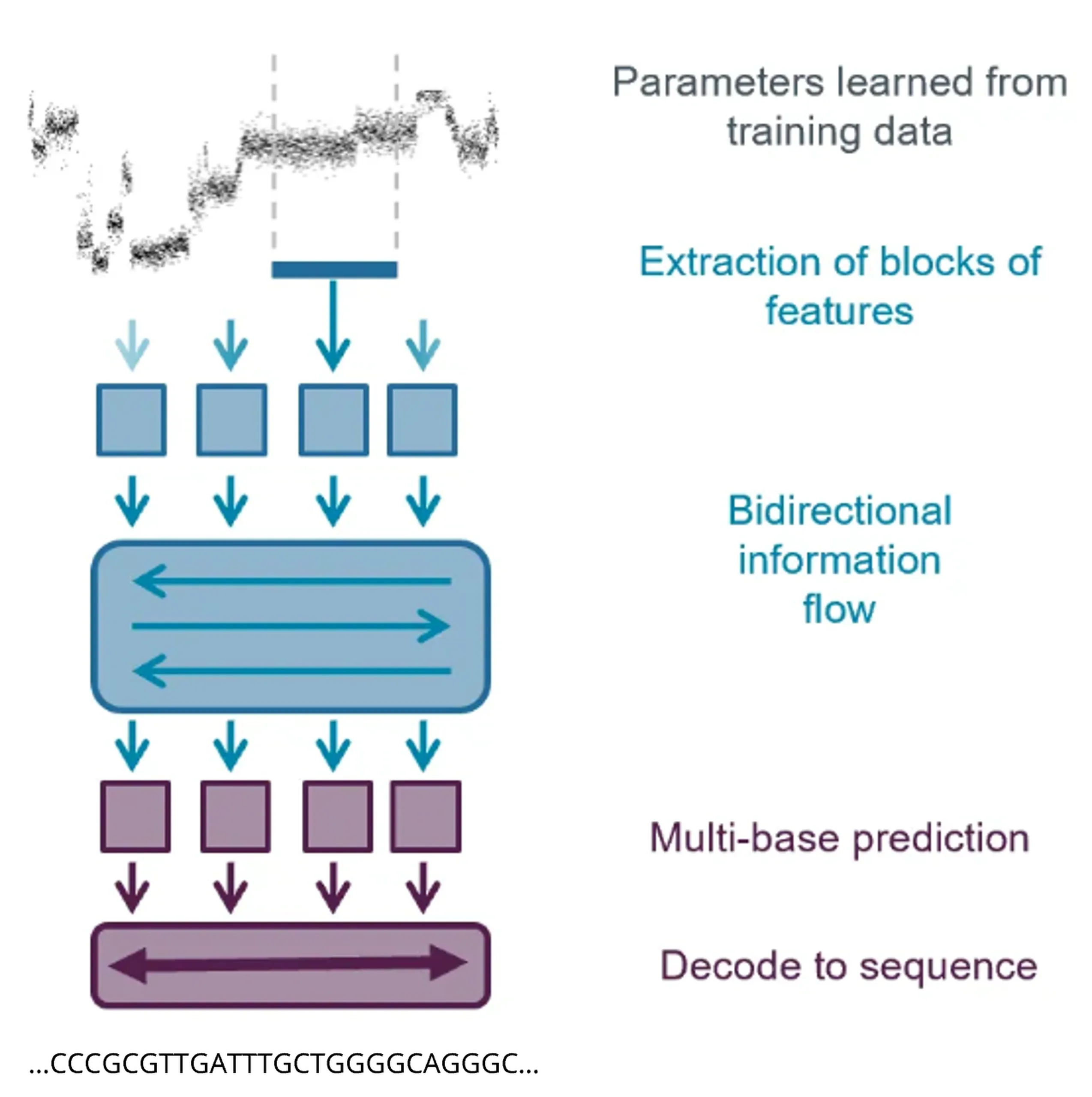
Choose the right basecalling model for your needs
Advances in nanopore design, sequencing chemistry, and basecalling models have increased raw-read single-molecule accuracy, supporting higher consensus and variant calling performance.
Our Dorado basecaller offers two models, allowing you to balance accuracy, speed, and available computational resources.
- High accuracy (HAC): balances high accuracy with computational efficiency and is recommended for most applications
- Super accuracy (SUP): prioritises highest single-read accuracy, with greater computational requirements. It is recommended for de novo assembly or low-frequency variant analysis
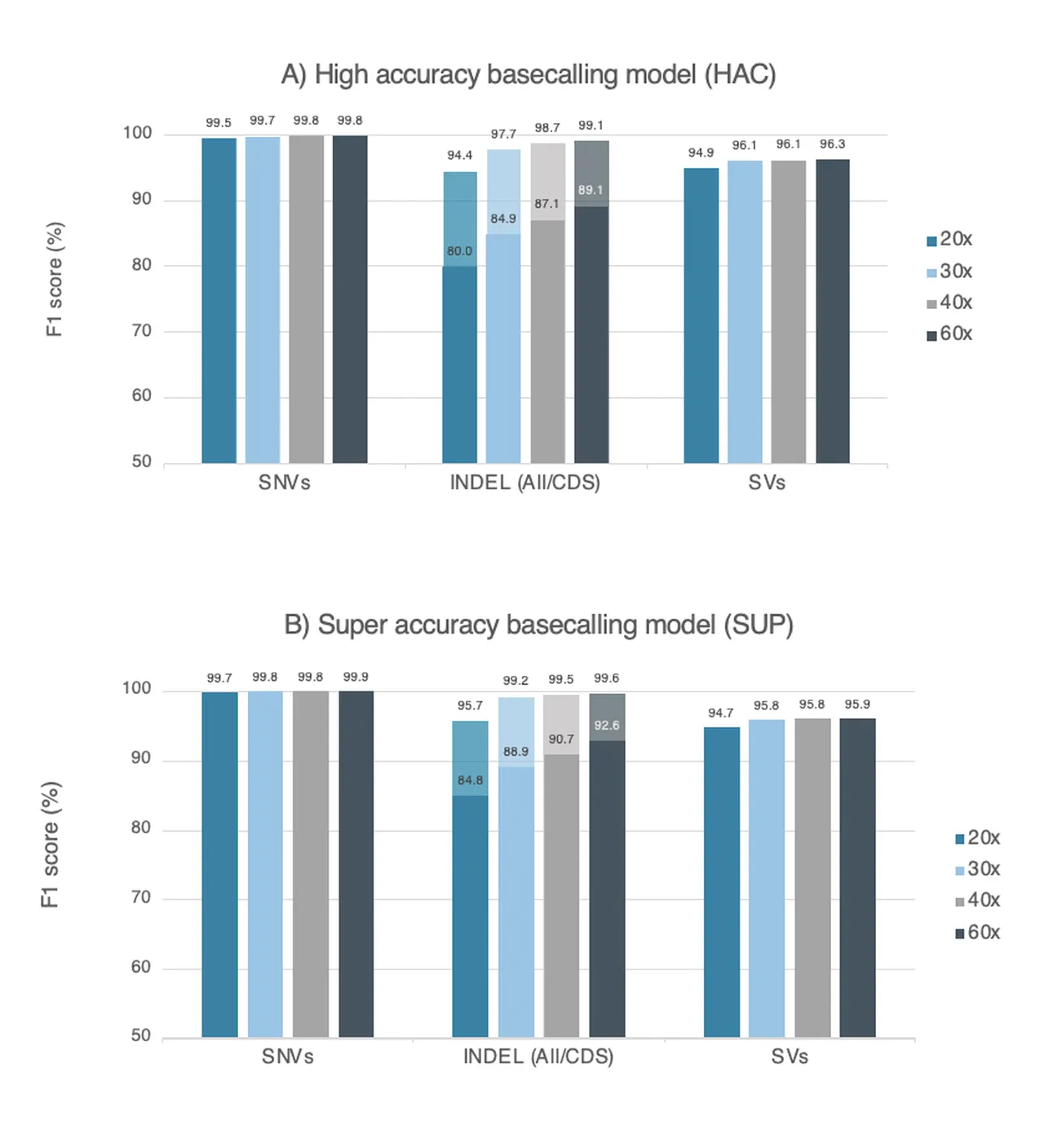
Figure: Oxford Nanopore sequencing delivers highly accurate variant calling. Visit our accuracy and performance page for full details.
Accelerating basecalling
During sequencing, MinKNOW streams raw signal data continuously, meaning basecalling can begin even before a DNA or RNA strand has finished passing through a nanopore. To keep pace with sequencing, basecallers use graphics processing units (GPUs), which are better suited to this type of processing than central processing units (CPUs) as they can perform many calculations in parallel. This allows nucleotide sequence to be generated in real-time as sequencing progresses.
Our devices with integrated compute — GridION, PromethION 2 Integrated, and PromethION 24 — have powerful onboard GPUs for real-time basecalling. Modification calling, barcode demultiplexing, and alignment to a reference genome can also take place during live sequencing, giving you fast insights into your data.
Get in touch
Subscribe
Talk to us
If you have any questions about our products or services, chat directly with a member of our sales team.