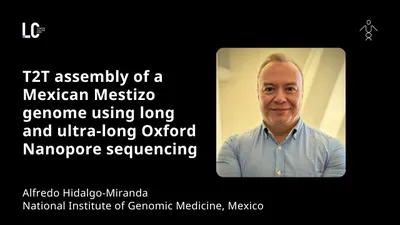
Assembly of an almost complete T2T Mexican Mestizo genome using long and ultra-long nanopore sequencing | LC26
- Published on:
Abstract
Multiple international efforts aim to better characterize human genomic variation and generate complete, representative human genome references. High-quality, gapless human genome assemblies have traditionally required the integration of multiple sequencing technologies, limiting their accessibility in many settings. Recent advances in long- and ultra-long-read sequencing, together with improved assembly algorithms, now enable chromosome-scale human genome assemblies using single long-read platforms. We report the first gapless, chromosome-scale human genome assembly from a Mexican Mestizo individual generated using Oxford Nanopore Technologies (ONT) data, combining long-read (≥40x coverage, N50 ≥30 kb) and ultra-long-read (~5x coverage, N50 ≥120 kb) sequencing. Assembly completeness and reference coverage were evaluated relative to the telomere-to-telomere CHM13v2.0 human reference genome. The resulting assembly is gapless and chromosome scale, comprising ~41 contigs with an N50 of approximately 147 Mb and contiguity approaching telomere-to-telomere levels, including 18 contigs with telomeric sequences at both ends. Using QUAST-derived alignments, we quantified CHM13 reference intervals lacking alignment support. Reference-uncovered bases were enriched on chrY, chr9, chr1, chrX, and the acrocentric chromosomes (13, 14, 15, 21, and 22). Detailed analysis showed that uncovered regions on non-acrocentric chromosomes, including chr4 and chr5, were tightly clustered within pericentromeric intervals (~48–55 Mb), far from telomeres and gene-rich chromosome arms. These regions consisted of multiple fragmented blocks rather than continuous deletions, consistent with alignment ambiguity and sequence divergence within satellite-rich heterochromatin. In conclusion, comparison to CHM13v2.0 demonstrates near-complete euchromatic coverage by the ultra-long ONT assembly. Residual reference-uncovered bases are overwhelmingly confined to pericentromeric, acrocentric, and sex chromosome regions, indicating that remaining gaps primarily reflect repeat-driven alignment limitations rather than assembly incompleteness. We are now sequencing familial trios with high Amerindian ancestry using this approach to improve haplotype phasing as part of a major Mexican Pangenome initiative.
Biography
Alfredo Hidalgo-Miranda is Principal Investigator in the Cancer genomics laboratory of the National Institute of Genomic Medicine in Mexico City. His research is focused on the genomic analysis of human cancer and the application of genomic analysis tools to improve the understanding of genetic variation in the Mexican population.