Microbial genomics
Getting started guides
:quality(80))
A guide to microbial sequencing with Oxford Nanopore
A guide to get started with sequencing microbial samples with Oxford Nanopore.
Most viewed
:quality(80))
Oxford Nanopore sequencing solutions for microbiology and infectious disease research
In this brochure, discover Oxford Nanopore sequencing techniques that can reveal multidimensional insights for your microbial research applications.
:quality(80))
A successor to Sanger: accurate, full-length, and haplotype-resolved amplicon sequencing with Oxford Nanopore
In this application note, we evaluate Oxford Nanopore sequencing for amplicon analysis using matched datasets generated with both Oxford Nanopore and Sanger sequencing.
:quality(80))
Oxford Nanopore sequencing provides superior metagenome-assembled genome recovery and strain-level resolution from a complex microbiome
In this application note, we demonstrate the
capabilities of Oxford Nanopore metagenomics by
sequencing and analysing the well-characterised
ZymoBIOMICS Fecal Reference.
:quality(80))
Oxford Nanopore whole-genome sequencing of foodborne pathogens
In this application note, we demonstrate the suitability of Oxford Nanopore sequencing as a standalone platform for foodborne pathogen whole-genome sequencing.
:quality(80))
GridION: one sequencer for many
Made with multiple projects and teams in mind, GridION gives you the freedom to start, stop, and scale your sequencing experiments without impacting others. Meanwhile, onboard compute keeps your real-time data optimised. Discover more.
Workflow overviews
:quality(80))
Nanopore-only microbial isolate sequencing solution (NO-MISS): flexible, rapid bacterial and fungal isolate whole-genome sequencing
This end-to-end workflow provides a rapid solution for whole-genome Oxford Nanopore sequencing of bacterial and fungal isolates.
:quality(80))
Streamlined identification of bacteria, archaea, and fungi with Oxford Nanopore microbial amplicon barcoding
This end-to-end workflow introduces how to sequence the full length 16S gene and ITS region with Oxford Nanopore technology.
:quality(80))
Rapid and complete plasmid characterisation with Oxford Nanopore sequencing
This end-to-end workflow is a rapid method for complete, high-quality whole-plasmid characterisation.
:quality(80))
Rapid viral sequencing for genomic surveillance of mpox using metagenomic or targeted approaches
This end-to-end workflow provides guidance for both metagenomic and targeted viral genome sequencing to deliver rapid and actionable results.
:quality(80))
Rapid identification of respiratory pathogens with Oxford Nanopore metagenomics
This end-to-end workflow introduces how to rapidly identify bacterial, fungal, and viral pathogens from respiratory research samples using metagenomic Oxford Nanopore sequencing on a MinION or GridION.
Featured resources
:quality(80))
Pan-microbial pathogen detection in hours using metagenomic sequencing
In this case study, discover how the UK NHS Respiratory Metagenomics Network have developed a rapid Oxford Nanopore sequencing workflow that can detect the bacteria, viruses, fungi, and parasitic pathogens underlying respiratory infections in a matter of hours.
:quality(80))
Delivering the future of genomic pathogen surveillance with Oxford Nanopore sequencing
Achieve comprehensive, affordable, and real-time analysis of human and animal pathogens with nanopore sequencing.
:quality(80))
Addressing the challenges of metagenomics with Oxford Nanopore sequencing
Explore how reads with unrestricted length are revealing unprecedented insight into microbial communities.
:quality(80))
High-quality bacterial genomes without the complexity
In this case study, researchers show that near-complete bacterial genomes can be assembled using nanopore sequencing alone.
:quality(80))
Wastewater sequencing — an early warning system for infectious disease outbreaks
Monitoring the genomic characteristics of pathogens circulating in a population can reveal important insights into the epidemiological dynamics of an outbreak. Unfortunately, sequencing every confirmed positive sample in a densely populated area is both challenging and expensive. Since viruses are s
Protocols
Microbial Amplicon Barcoding Sequencing for 16S and ITS (SQK-MAB114.24)
Step-by-step protocol for microbial 16S and ITS amplicon sequencing using the Oxford Nanopore Microbial Barcoding Kit.
:quality(80))
Solución de secuenciación de aislados microbianos solo con tecnología Nanopore (NO-MISS) a partir de cultivos celulares y el kit SQK-RBK114 (.24 o .96)
Nanopore-only Microbial Isolate Sequencing Solution (NO-MISS) from cell cultures using SQK-RBK114 (.24 or .96)
Secuenciación rápida de ADN V14 - con códigos (SQK-RBK114.24 o SQK-RBK114.96)
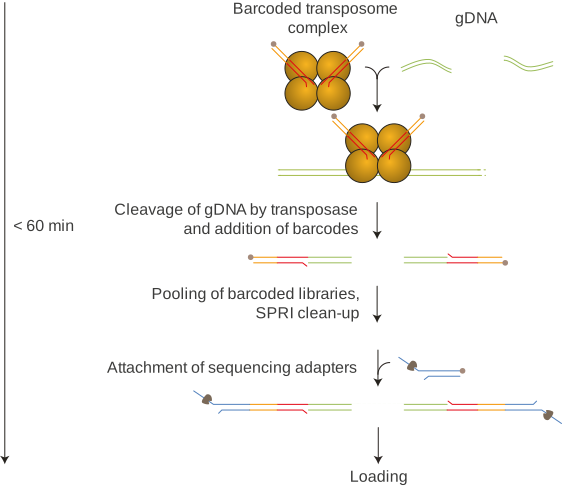
Learn how to perform rapid genomic DNA barcoding using the Rapid Barcoding Kit V14 (SQK‑RBK114.24 / SQK‑RBK114.96). This fast, high‑yield library preparation workflow enables multiplexing of up to 96 gDNA samples with ~60‑minute prep time and compatibility with R10.4.1 flow cells.
Analysis workflows
Latest research
:quality(80))
Strengthening MRSA genomic surveillance in the Pacific
Discover how strengthening local sequencing and bioinformatics capacity can support sustainable pathogen surveillance and informed public health responses across the Pacific.
:quality(80))
LOAM: a family of genomic language models trained on long-read soil metagenomes
Authors: Quentin RV. Ferry, Maurice Frank, Julia Jehn, Matthias Schaks, Bruno R. Steinkraus, Timothy Rajakumar
:quality(80))
Exploring the methylation dimension
Watch this webinar to learn more about leveraging Oxford Nanopore gold standard methylation sequencing in your research.
Metagenomics and microbial bioinformatics: latest tools and workflows
In this video, researchers discuss practical research applications, current challenges, and future directions in microbial bioinformatics. We explore how Oxford Nanopore sequencing can characterise complex microbial communities at greater resolution than legacy methods.
Advancing clinical metagenomics for patient care in India
Explores how distributed clinical metagenomics could be implemented at a large scale across India, with insights that can extend to healthcare systems globally.