Oxford Nanopore in the Galapagos: genomes of endemic birds for conservation genomics | LC26
- Published on:
Abstract
The Galápagos Islands are a globally recognized biodiversity hotspot, home to thousands of endemic species that often have small population sizes and rely on intact ecosystems for survival. Since human arrival in the 1500s, the introduction of invasive species — combined with hunting, fishing, and habitat destruction — has reduced native populations, lowered genetic diversity, and pushed many species toward extinction. Two species of particular conservation concern are the Critically Endangered Galápagos Petrel and the Lava Gull, the rarest gull in the world. Despite its Vulnerable status, genomic resources for the Lava Gull are lacking, with only a scaffold-level genome available for a related species. Similarly, genetic studies of the Galápagos Petrel have relied primarily on microsatellites, leaving its genomic status largely unknown. High-quality genomes for both species are essential for enabling population genomics, monitoring, and conservation management. Recent advances in low-cost portable sequencing platforms now make genomic data collection feasible in remote environments such as the Galápagos, where sample export is restricted under the Endangered Species Act (ESA) and the Nagoya Protocol. Sequencing in situ builds local capacity, supports conservation initiatives, and ensures compliance with strict regulations. Here we present the first assembled whole genomes of the Galápagos Petrel (Pterodroma phaeopygia) and the Galápagos-endemic Lava Gull (Leucophaeus fuliginosus), generated entirely in the islands using a PromethION 2 Solo device. The Lava Gull assembly spans 1.31 Gb (scaffold N50: 85.1 Mb), and the Galápagos Petrel genome spans 1.35 Gb (scaffold N50: 74.2 Mb). Both assemblies exhibit exceptionally high benchmarking universal single-copy orthologs (BUSCO) completeness (99.95%), and include recovered W and Z chromosomes. These chromosome-level assemblies provide foundational resources for comparative genomics, conservation planning, and functional studies of island-endemic avifauna, demonstrating that improved Oxford Nanopore Technologies workflows can produce high-quality genomes suitable for long-term conservation genomics in the Galápagos.
Biography
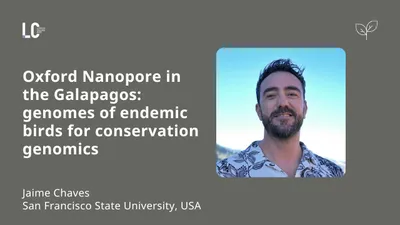
Jaime Chaves’ research centers on understanding how biodiversity is generated and maintained in the Neotropics, with a particular emphasis on the connection between molecular variation and phenotypic traits. He applies phylogenetic comparative methods and integrates data from fieldwork and museum collections to investigate evolutionary histories of organisms, addressing fundamental questions in biodiversity. By combining molecular genetics with field biology, Jaime explores evolutionary processes at multiple levels: from population divergence and speciation in action, to species-level phylogeography and systematics. His projects are grounded in international, multidisciplinary collaborations that actively engage local students and communities. While he employs molecular techniques across a variety of taxa, Jaime is especially drawn to birds for their remarkable diversity and life histories, and most of his work focuses on species on the Galápagos Islands.


