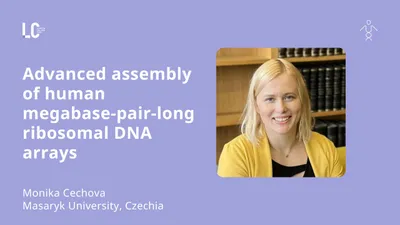
Advanced assembly of human megabase-pair-long ribosomal DNA arrays | LC26
- Published on:
Abstract
Ribosomal DNA (rDNA) represents the last frontier of human genomics, and rDNA gaps are the last missing pieces in diploid telomere-to-telomere assemblies. To close these gaps and better understand this essential region critical for protein synthesis and genome stability, we optimized multiple rDNA enrichment, basecalling, hybrid error-correction, and assembly strategies, as well as signal-based methods. Initial efforts using the Oxford Nanopore Technologies (ONT) experimental basecalling model (where we observed an increase of 31.4% to 46.5% of >Q25 reads) reproducibly reconstructed a large, megabase scaled rDNA array from chromosome 14. Our dataset integrates whole-genome sequencing (WGS) and adaptive sequencing reads with coverages of 62x and 29x, providing a resource with the potential to serve as a benchmark for rDNA assembly development. This allowed us to study the structural variation (i.e. long repeat and tandem repeat copy number), as well as small variation. A subset of this variation may be functional, as G-quadruplexes with high prediction scores were frequently localized to variable blocks across rDNA units. We describe distinct methylation patterns between the active and inactive arrays: the maternal array displayed periodic hypo- and hypermethylation, whereas the paternal array showed uniformly hypermethylated rDNA units across its entire length. Overall, approximately 41% and 59% of the reads exhibited active and inactive signatures, allowing for an independent assembly. Finally, single-unit profiling revealed stable transmission of copy number and methylation across the three generations. Overall, the ultra-long reads and native signal generated by ONT uniquely position this platform for routine telomere-to-telomere (T2T) assembly and resolution of highly repetitive rDNA regions.
Biography
Monika Cechova is an Assistant Professor at Masaryk University with an interest in the most repetitive parts of the human genome, including centromeres and especially the Y chromosome, including the world’s first complete reading of the human Y. Monika’s goal is for everyone to have access to their complete genetic information for the personalized medicine of the future. She was awarded Czexpats in Science Award for her efforts to create an open, collaborative bioinformatics and genomics community in the Czech Republic.